
Expert Support
(844) 344 - 4465
(844) 344-4465

Position the shaft so that the coil sits level just above the ground, and your arm hangs relaxed. Position the cuff so it ends just below the elbow and keep your wrist straight. Check the balance at the grip, and if the detector still feels front-heavy after a test walk, add a harness or bungee. Check coil bolts and shaft locks before departure.
People hunt differently on cool mornings. The quick park session near the car turns into a walk across a harvested field, and two hours, six. Normally, on a day like this, your arm will quit before your batteries do.
Most of that fatigue comes from setup, not fitness. A shaft one notch too long, a cuff pressing in the wrong spot, a coil pulling the front end down, or a digger bouncing on one hip all add effort to every swing. Over a few thousand swings, it adds up.
This guide covers metal detector shaft and harness setup from the ground up: finding the right length, fitting the cuff, checking balance, deciding on a harness, carrying your tools, and running a quick check before you lock the truck. If you are also picking a coil for open ground this season, our guide to coils for freshly harvested fields pairs well with this one.
There is no correct length, as it is determined by your height, arm length, and how you hold the detector. Here is the result. Stand up straight with your arm in the cuff and let it hang down at your side. The coil should sit level and just off the ground, close enough to skim over stubble without dragging.
A shaft that is too short shows up fast. You hunch to keep the coil down, and your lower back lets you know by lunchtime. Too long is harder to spot. Your arm ends up held forward and raised, the coil tips upward at the end of each swing, and your shoulder does the work your stance should be doing.
Change the length one notch at a time, then swing for a full minute before you judge it. Small changes feel bigger than they look.
Very tall and very short detectorists sometimes run out of adjustment on the stock shaft. That is when a replacement upper, middle, or lower shaft makes sense. Shafts are designed to fit specific models and detectors from the same manufacturer and often have different fittings, so match the listing to your exact detector rather than the brand name. Detector Warehouse stocks model-specific options like the carbon fiber lower shaft for the Manticore, the carbon lower shaft for the Equinox 700 and 900, and the Nokta lower shaft for Impact and Invenio. Browse the entire range in our shafts and poles collection.

XP S-Telescopic Stem With Armrest
Telescopic length adjustment plus a built-in armrest. Sold without the lower stem, so you pick the lower section you prefer.
Prices checked on detectorwarehouse.com, October 21, 2026.
Field edges often hold older finds, and they are also where a full-length shaft starts catching on brambles and low branches. Close to cover, a shorter setup is easier to steer and lets you work the coil into gaps under hedges.
Some detectors handle this with the stock shaft. The Garrett ATX, for example, can be run fully extended, fully collapsed, or at any point in between. Others need a compatible travel handle or short shaft, which also makes the detector easier to pack for a long walk in. Check the shaft options for your model before you buy.
The trade-off is reach. Go too short, and you will be stooping and covering less ground per swing, which defeats the point on open ground. Shorten for the woodland edge, then return to your normal length when you step back into the field.
The arm cuff carries a large share of the detector's weight, so where it sits matters. Slide your forearm in and take the grip. The back of the cuff should end just below the elbow, supporting the forearm without pressing into the joint. If you can feel a hard edge after ten minutes, it is in the wrong place.
The strap should hold your arm in the cuff without squeezing. An overtightened strap makes your hand tire faster.
Your wrist should stay straight, in line with your forearm, through the whole swing. If it bends up or down to keep the coil level, the cuff position or shaft length needs another look. Swing from the shoulder and let the forearm and cuff move as one piece.
Stock cuffs do not suit everyone. Some are too wide for a slim forearm and let the detector wobble. Others have worn padding or a stretched strap. When adjustment cannot fix it, a replacement armrest made for your model is a small change you will feel on every swing. Like shafts, these are model-specific, so check the compatibility list before ordering.

Replacement arm cup, rear stand, arm strap and fastening screw. A simple fix for worn padding or a tired strap.
Prices checked on detectorwarehouse.com, October 21, 2026.
The cold hands cause a second problem. In the cold morning you grip more tightly, and a tight grip fatigues the forearm. Thin detecting gloves with a grippy palm generally work better than bulky winter gloves because you still need finger feel to pick a small find out of a clod. Save the heavier gloves for days when the cold is the bigger problem. Here are gloves and our other metal detector accessories.
If you’re experiencing persistent or worsening wrist or elbow pain between hunts, stop and have it checked by a medical professional rather than adjust your way through it.
Three hours can feel very different to two detectors of the same weight. The thing is where the weight is. The size of the coil, length of the shaft, and where the control box and battery are placed dictate how hard the front end pulls on your grip.
This is clearly illustrated in the selection of the coil. The GPX 6000 is listed by Minelab as weighing 2.1 kg (4.6 lb) with the 11" mono coil and 2.3 kg (5.1 lb) with the 14" DD coil. That extra half-pound is right out at the very end of the shaft, the worst place to put added weight. The same effect is achieved with a larger aftermarket coil on any machine.
| Detector | Setup | Listed weight | vs. 5 lb guide |
|---|---|---|---|
| Minelab GPX 6000 | 11" mono coil | 4.6 lb (2.1 kg) | Under |
| Minelab GPX 6000 | 14" DD coil | 5.1 lb (2.3 kg) | At the mark |
| Garrett ATX | Standard package | About 7 lb | Over |
| Minelab GPZ 7000 | GPZ 14 coil, coil cover, 72Wh battery | 7.32 lb (3.32 kg) | Over |
GPX 6000 and GPZ 7000 figures are Minelab published specs. The ATX figure is an approximate dealer listing, so confirm against Garrett's spec for your package.
Put your arm in the cuff, hold the grip, and relax the hand. If the coil hits the ground quickly, the detector is front-heavy, and your forearm will be holding it up all day. Then evenly swing twenty times. If your swing shortens or the coil lifts at the ends, the balance is working against you.
The usual reaction is to grip harder, and that is exactly what wears you out. Better fixes are a shaft setting that still suits your stance, a lighter coil for long days, or support that takes the weight off your arm, which is where a harness comes in.
A harness or bungee takes some of the weight of the detector off your forearm and puts it on your shoulders and back. Your arm still guides the swing, but it no longer bears the full weight for six hours a day.
A good starting point is around 5 lb. Support is most important for detectors near or above that level or that feel front-heavy in the grip. It’s a rule of thumb; not a requirement. A light, well-balanced machine might not need one, and a heavy detector that you swing for an hour might not either.
Obvious candidates are heavier gold machines. Owners of the GPZ 7000 (see our GPZ 7000 review), the Garrett ATX, and heavier GPX series setups tend to be the first to feel it. Signs you would benefit: forearm burn in the first hour. Shrinking swing. Shoulder ache that drags into the next day.
There are two basic styles. Light and simple is a bungee sling over one shoulder. A full harness provides more adjustment, distributing the load across both shoulders and the back. A third option for a few specific detectors is a chest harness that carries the control box against your body, rather than on the shaft.

Eight adjustment points, eight attachment points for gear, left or right hand setup, and a universal S-cuff for Minelab detectors.

Moves the control box from the shaft to your chest on compatible Fisher setups, with adjustable belt and shoulder straps.
Prices checked on detectorwarehouse.com, October 21, 2026. See every option in our metal detecting harness collection.
Firstly, put the harness on your body without the detector. Centered backpad, snug straps, nothing pressing on your neck.
Then clip in the detector. Set the bungee so the coil hovers at the same height you set with the shaft. Too much tension lifts the coil at the ends of the swing. Too little and you are carrying the weight again.
Next, check the coil lead. There should be slack at both ends of the full-width swing,, and it should not rub on the bungee or clip. Be sure the coil is free to move and remains level all the way.
Walk for ten minutes near the car. Dig a test hole: release, dig, clip back in. If any of that feels awkward, fix it now rather than two miles out.
Six hours on a digger, hanging off one hip, leaves you a bit crooked the whole time. Share the load. Put the digger on the side of your belt opposite your swing arm, the pinpointer where your free hand can reach it without twisting, and the finds pouch toward the middle of your belt.
A holster keeps the pinpointer upright and within reach, so you are not fishing in a pocket fifty times a day. Add a lanyard as well. Pinpointers are easy to set down beside a hole and walk away from, and fall stubble hides them well. If you are new to pinpointing, our guide on how to use a pinpointer covers the basics.
Near hedgerows, anything dangling catches. Keep the digger in a sheath, tuck lanyards close, and keep harness straps flat. For water and extras on a long walk, a small backpack carries the load better than an overloaded belt.

Nokta Premium Edge Digger with Finds Pouch
7.5" stainless blade with a belt holster, plus a pouch with an adjustable belt and webbing for clipping on a pinpointer.
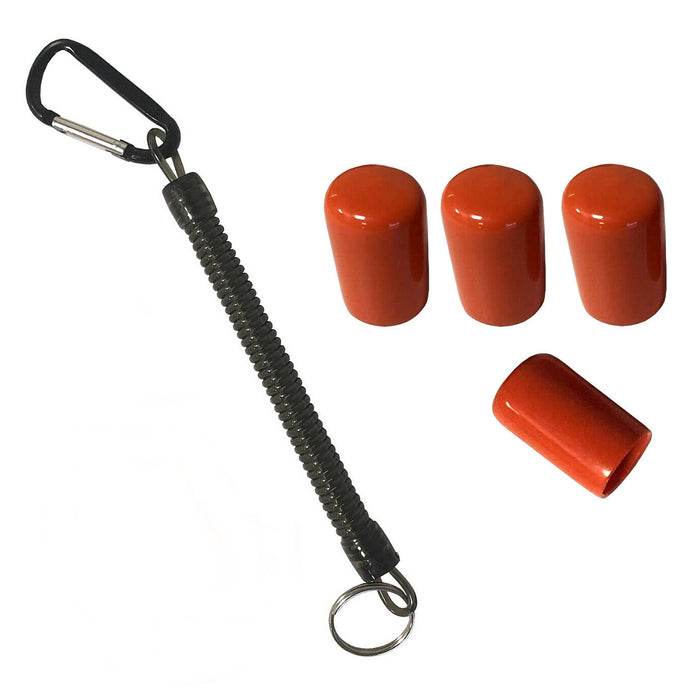
Pinpointer Tip Protectors and Lanyard
Four tip protectors plus a lanyard that extends from 8.5" to 51", so the pinpointer stays attached while you dig.
Prices checked on detectorwarehouse.com, October 21, 2026. More options in our digging tools collection.
A loose coil joint is easy to miss at home and frustrating in the field. If the bolt has worked loose, the coil can rattle, wobble, or slowly tip off angle, and you spend the day correcting it with your wrist. Check the coil bolt, washers, coil mounting ears, and shaft locks. Gently move the coil: it should hold its angle.
Tighten to the manufacturer's guidance and no further. Plastic bolts and coil ears crack when overtightened, and a cracked ear is a bigger repair than a bolt.
If the washers are worn or the threads damaged, replace the hardware with a kit made for your model. Bolts are not universal even within one brand, so check the compatibility list on the listing. A spare kit costs less than a tank of gas, and Nokta's hardware set comes in under $7. Keeping one in the truck can save a day from ending early.
One caution: fix the movement, but do not assume a loose bolt explains odd sounds from the detector. Electrical noise has other causes, so judge the audio separately.

Replacement bolts and rubber washers to keep the coil secure on compatible Minelab models.

Nokta Replacement Coil Hardware
Nut, bolt and two rubber washers. Listed for the Invenio, Impact, Simplex+, Kruzer, Gold Kruzer and other Nokta models.
Prices checked on detectorwarehouse.com, October 21, 2026. Browse more hardware in metal detector parts.
Before you lock the truck, run through this:
Shorter fall days also mean colder batteries, so pair this checklist with our tips on making the battery last a full fall hunt.
Good fit and balance will not make the field any smaller, but they decide whether hour five feels like hour one. Shop compatible harnesses, cuffs, shafts and hardware for your detector, or talk to our team if you are unsure what fits.
Shop Harnesses Shop ShaftsCall 844-344-4465 for fit questions.
Long enough that the coil sits level just above the ground while you stand upright with your arm relaxed in the cuff. No single measurement suits everyone, so adjust one notch at a time and test with a few swings.
Not always, but it helps most on detectors around 5 lb or heavier and on any machine that feels front-heavy. If arm fatigue sets in within the first hour, a harness or bungee is worth trying.
Fix the setup before blaming your stamina. Correct shaft length, a cuff that ends below the elbow, a straight wrist and good balance do most of the work. Add support for heavy machines and take short breaks before your arm gets sore.
Yes. Manufacturers sell replacement armrests for many models, but they are model-specific. Match the replacement to your exact detector, not just the brand.
Shaft locks, cuff position, balance, harness tension, tool placement and the coil bolt. Then walk a few minutes near the car. Ten minutes of testing beats a long walk back to fix something.
If the coil wobbles, rattles, or will not hold its angle after tightening to the manufacturer's guidance, or the washers are cracked or missing, replace the hardware. A shaft lock that slips under light pressure needs cleaning or replacing.
{"one"=>"Select 2 or 3 items to compare", "other"=>"{{ count }} of 3 items selected"}


Leave a comment