
Expert Support
(844) 344 - 4465
(844) 344-4465

Updated: November 6, 2026
Garrett sells the Vortex in three versions, but there is only one detector underneath. The VX5, VX7 and VX9 share the same control box, stem, searchcoil, battery and 16 ft waterproof housing. What separates them is the software: how many frequencies you can pick, how many search modes you get, how much the Target ID screen tells you, and how far you can adjust recovery speed and iron handling. This guide lays out exactly what each model can and cannot do, so you can pick the right starting point and know what an upgrade would add later.
The world’s first fully upgradeable waterproof detector series! As your skills increase, you can opt to convert your VX-5 to a VX-7 or VX-9 model with software updates. Each Vortex model upgrade includes additional operating frequencies, more advanced features, and more power!
Garrett’s Multi-Dimensional Multi-Frequency (MD-MF) Technology provides deeper and more accurate target analysis and identification. Targets are detected and analyzed using simultaneous multiple frequencies as well as utilizing multiple dimensions of conductivity and ferrous (iron) content.
This advanced MD-MF analysis takes places within all three Vortex models. It is most visible on the VX-9 model, whose LCD includes a multi-axis Target ID with three distinct scales.
All three models are waterproof to 16 ft (5 m), weigh 3 lb with the supplied 8.5" x 11" DD Raider coil, run Garrett's MD-MF technology and support Z-Lynk wireless headphones. The differences are software features, and Garrett sells official paid upgrades that unlock the higher models on the same detector.
Best starting point. 13 kHz and Multi-Frequency, one Target ID scale (0 to 99), four search modes, fixed recovery speed, and fixed Bottlecap Reject and Iron Boundary.
Choose it for parks, yards, fields, dry sand and freshwater on the lowest budget.
Best balance. Adds 5 kHz, Multi-Salt, Beach Mode, two-tier Target ID, two recovery speeds, four Bottlecap Reject and Iron Boundary settings, and a 3 or 5 tone choice.
Choose it if you hunt saltwater beaches or want real adjustment without paying for VX9.
Most control. Five single frequencies plus Multi-Frequency and Multi-Salt, three-tier Target ID, seven modes including Thin Coins and Fast, three recovery speeds and six Bottlecap Reject and Iron Boundary settings.
Choose it for trashy sites, relics, thin or hammered coins and competition hunts.
The Vortex series is Garrett's waterproof, multi-frequency platform built around MD-MF technology. MD-MF looks at a target and the surrounding soil across several dimensions of conductivity and ferrous content, then turns that into a Target ID. Every Vortex model runs this analysis. The higher models simply show you more of it and give you more ways to act on it.
Because the three models use identical hardware, Garrett can sell the difference as software. You can buy a VX5 today and later unlock VX7 or VX9 features through an official firmware upgrade, with no trade-in and no new parts. Free firmware updates are offered separately for every model to refine performance and fix issues.
The physical package is the same on all three. The shaft collapses to 24.75" (62.86 cm) for travel and extends to 56.75" (144.14 cm). Total weight is 3 lb (1.38 kg) with the 8.5" x 11" DD Raider coil. Power comes from an internal lithium-ion battery that Garrett rates at about 15 hours of typical use, depending on settings. It charges through a waterproof USB-C port, and Garrett recommends a 10 W (2 A) or stronger charger for the fastest charge. If the battery runs flat in the field, the detector can run from a 5 V USB power bank. Each model carries a 3-year limited parts and labor warranty.
If you are also weighing Garrett's older platform, our Garrett AT vs Vortex comparison covers that decision, and our guide to multi-frequency technology explains why simultaneous frequencies matter.
The table below follows Garrett's current Vortex comparison chart and owner's manual.
| Feature | Vortex VX5 | Vortex VX7 | Vortex VX9 |
|---|---|---|---|
| Position | Entry level, lowest price | Balanced step-up with beach capability | Full-control professional model |
| Target ID scale(s) | One scale, 0 to 99 | 2-tier: non-ferrous and ferrous | 3-tier: two ferrous scales plus non-ferrous |
| Single frequencies | 13 kHz | 5, 13 kHz | 5, 9, 13, 18, 25 kHz |
| Multi-Frequency | Yes | Yes | Yes |
| Multi-Salt | No | Yes | Yes |
| Search modes | 4: Zero, Standard, USA Coins, Custom | 5: Zero, Standard, USA Coins, Beach, Custom | 7: Zero, Standard, USA Coins, Thin Coins, Beach, Custom, Fast |
| Recovery Speed | Fixed | 2 settings | 3 settings |
| Bottlecap Reject | Fixed | 4 settings | 6 settings |
| Iron Boundary | Fixed | 4 settings | 6 settings |
| Number of tones | 3 | 3 or 5 | 2, 3 or 5 |
| Increased sensitivity / depth (Garrett listing) | Not listed | Yes | Yes |
| Notch Discrimination | Yes | Yes | Yes |
| High-Resolution Iron Discrimination | Yes | Yes | Yes |
| Sensitivity settings | 8 | 8 | 8 |
| Iron Audio and Iron Volume | Yes | Yes | Yes |
| Z-Lynk wireless | Yes | Yes | Yes |
| Ground balance | Auto, 175 points | Auto, 175 points | Auto, 175 points |
| Frequency shift (EMI channels) | Yes, 8 | Yes, 8 | Yes, 8 |
| Pinpoint and LCD backlight | Yes | Yes | Yes |
| Length | 24.75" to 56.75" | 24.75" to 56.75" | 24.75" to 56.75" |
| Weight with 8.5" x 11" coil | 3 lb (1.38 kg) | 3 lb (1.38 kg) | 3 lb (1.38 kg) |
| Waterproof depth | 16 ft (5 m) | 16 ft (5 m) | 16 ft (5 m) |
| Searchcoil included | 8.5" x 11" DD Raider | 8.5" x 11" DD Raider | 8.5" x 11" DD Raider |
| Battery | Internal Li-ion, about 15 hrs, USB-C | Internal Li-ion, about 15 hrs, USB-C | Internal Li-ion, about 15 hrs, USB-C |
| Warranty | 3 years, limited parts and labor | 3 years, limited parts and labor | 3 years, limited parts and labor |
| Upgradeable? | Yes, to VX7 or VX9 | Yes, to VX9 | Top model, free firmware updates |
On a phone, swipe the table sideways to see all three models.
The VX5 is the entry model, but it is not a stripped-down machine. It has the same hardware as the VX9 and the same MD-MF processing, with a smaller set of features switched on.
You get two frequency choices: a single 13 kHz frequency or simultaneous Multi-Frequency. Multi-Frequency is the default in every mode and is the setting most owners leave on, since it handles a wide range of targets in most soils while keeping ground noise down. The 13 kHz option is a good general frequency for coins, jewelry and relics, and a single frequency can run quieter where electrical interference is heavy.
Targets show on one Target ID scale from 0 to 99. Iron reads toward the left, low conductors such as nickels, small jewelry and thin coins land in the middle, and high conductors such as large silver coins read to the right. With three audio tones and four search modes (Zero, Standard, USA Coins and Custom), it is the easiest Vortex to learn.
Recovery speed on the VX5 is fixed. Garrett tunes it to respond quickly on targets that sit close together, so it is not slow, but you cannot change it. Bottlecap Reject and Iron Boundary also work in the background at fixed levels in Multi-Frequency, and you cannot adjust them. Iron Audio and Iron Volume are both included, which helps newer users manage iron noise.
Best for: new detectorists, park and yard coin hunting, school grounds, plowed fields, dry sand and freshwater lakes and rivers. The VX5 has no Multi-Salt or Beach Mode, so Garrett itself points regular saltwater hunters to the VX7 or VX9.

Garrett Vortex VX5 Multi-Frequency Waterproof Metal Detector
The entry Vortex with MD-MF multi-frequency, a simple single Target ID scale and full waterproofing.
$399.00$529.99
In stock
View ProductThe VX7 is the middle model and, for many buyers, the one that makes the most sense. It keeps everything the VX5 does and adds the features that matter most once you hunt beyond clean inland ground.
Frequency options grow to four: 5 kHz, 13 kHz, Multi-Frequency and Multi-Salt. Garrett describes 5 kHz as well suited to larger, highly conductive targets such as large silver coins. Multi-Salt is a separate multi-frequency blend built for wet salt sand and surf, and it is the default frequency for the new Beach Mode. That brings the VX7 to five search modes.
In Multi-Frequency, the VX7 shows a two-tier Target ID display: an upper non-ferrous scale and a lower ferrous scale. A complex target can show on both at once, which gives you a clearer picture before you dig than the single VX5 scale. Note that in Beach Mode and in single-frequency operation the display goes back to a single scale.
The VX7 also opens up adjustment. Recovery speed has two settings, listed on our product page as Standard and Fast. Bottlecap Reject and Iron Boundary each get four settings (0 to 3), and you can choose 3 or 5 audio tones. Garrett lists increased sensitivity and depth for the VX7 compared with the VX5, though it does not publish figures and real depth always depends on soil and target.
Best for: saltwater beach and surf hunters, detectorists moving past beginner level, and anyone hunting worked parks who wants to fine-tune iron handling without paying for the full VX9 feature set.

Garrett Vortex VX7 Multi-Frequency Waterproof Metal Detector
Adds saltwater capability and real adjustment to the Vortex platform at a middle price.
$499.99$629.99
In stock
View ProductThe VX9 is the full Vortex. It carries every VX7 feature and adds the most frequency choice, the most target information and the widest range of adjustment in the series.
You get five single frequencies (5, 9, 13, 18 and 25 kHz) plus Multi-Frequency and Multi-Salt, seven options in total. Garrett suggests the 25 kHz setting for tiny gold nuggets and hammered silver coins, while the lower frequencies favor larger, more conductive targets.
The three-tier Target ID is the feature VX9 owners mention most. In Multi-Frequency, the center scale shows non-ferrous targets, the lower scale shows common iron such as nails and wire, and the upper scale shows flat or complex iron such as steel bottlecaps and washers, the items that fool many detectors into reading as coins. Bottlecap Reject and Iron Boundary each get six settings (0 to 5) to work on those two iron types.
Two search modes are exclusive to the VX9. Thin Coins boosts response in a select Target ID range for gold coins, small Roman coins and thin hammered coins, while suppressing common iron and high conductors. Fast suppresses common iron and sets recovery speed to its highest level for competition hunts and heavy trash. Recovery speed has three settings in all.
The VX9 also adds a 2-tone option. Accepted targets give a high tone and everything else a low tone, with the break point adjustable up to 81. Relic hunters and cherry pickers like this because you still hear every target, just sorted into good and bad. Garrett lists more sensitivity and deeper detection for the VX9 than the VX7, again without published numbers.
Best for: experienced hunters, trash-heavy parks, relic sites, hammered or thin coins, competition hunts and anyone who hunts land and saltwater beaches and wants one detector for both.
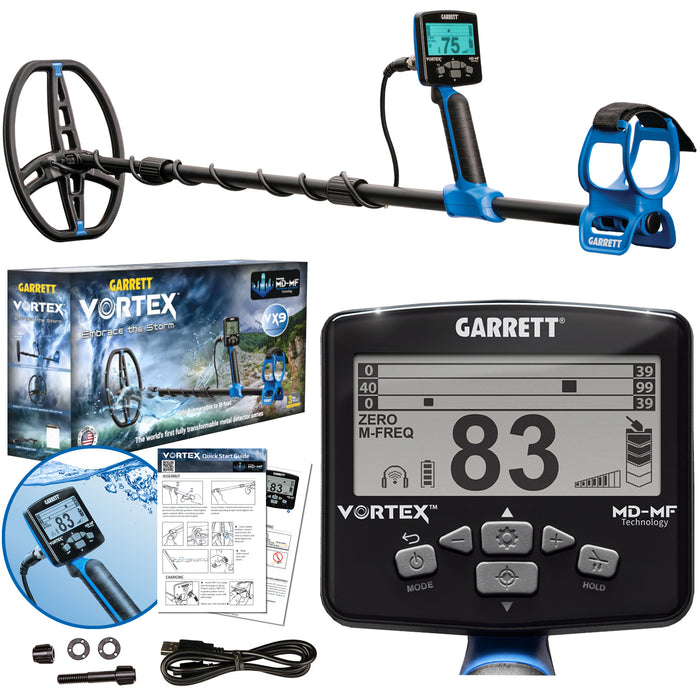
Garrett Vortex VX9 Multi-Frequency Waterproof Metal Detector
The full Vortex feature set for trashy sites, relics, thin coins and saltwater.
$599.99$699.99
In stock
View ProductEvery Vortex can run in two ways. In a single frequency, all of the transmitter's power goes into one frequency. In Multi-Frequency, the detector transmits a blend of frequencies at the same time and MD-MF analyzes the results together. These are different things: having more single frequencies to choose from is not the same as running several frequencies at once.
Why would you leave Multi-Frequency at all? Garrett's manual gives a few practical reasons. A single frequency can offer a slight edge on certain target types, and it can run quieter than Multi-Frequency where electrical interference is heavy. Lower frequencies such as 5 kHz tend to suit larger, highly conductive targets. Higher frequencies such as 18 and 25 kHz tend to suit small, low-conductive targets such as fine gold and thin hammered coins. The middle frequencies, 9 and 13 kHz, are general-purpose choices.
For most hunting on any model, Multi-Frequency is the place to start, which is why Garrett makes it the default in every mode except Beach. The extra single frequencies on the VX7 and VX9 are tools for specific targets and conditions.
A note on depth: more frequency options do not automatically mean more depth. Garrett does list increased sensitivity and depth for the VX7 and VX9 over the VX5, but that is a model-level claim without published figures. Real depth depends on target size, soil mineralization, coil and settings. Our article on improving detection depth covers the factors you can control.
Saltwater conducts electricity, and to a metal detector wet salt sand looks a lot like a huge, faint target. As you walk from dry sand into wet sand and then into the surf, the rising salt content can make a detector unstable: chatter, false signals and jumpy Target IDs. Multi-Salt is a frequency blend Garrett designed to counter that effect, and on the VX7 and VX9 it is the default setting for Beach Mode.
The VX5 does not have Multi-Salt or Beach Mode. That is the single biggest reason to choose a VX7 or VX9 if you live near the ocean. Garrett's own troubleshooting advice says that if ground balance reads below 50, which points to salty or conductive ground, you should switch to Multi-Salt. Some inland soils can behave the same way when wet, such as old sea beds and dry salt lakes, so Multi-Salt is not only for the beach.
It is important to separate waterproofing from saltwater detecting performance. All three Vortex models share the same housing and the same 16 ft (5 m) rating, so a VX5 can go into saltwater without damage. What it lacks is the frequency blend that keeps the detector stable and accurate in wet salt conditions. On dry sand, freshwater beaches, lakes and rivers, the VX5 is a capable choice.
Two practical notes for any Vortex in the water. Z-Lynk is a radio link and radio signals do not travel through water, so you need wired waterproof headphones when the control box is submerged. Below 6 ft, turn on the button lock so water pressure does not press the buttons. Rinse the detector in fresh water after saltwater use and make sure the connectors are dry before charging. You will find waterproof options in our headphones collection, and a good sand scoop makes recovery in the surf much easier.
All three models measure the same things. The difference is how much of that information reaches the screen when you run Multi-Frequency.
The practical value shows up on borderline targets. A steel bottlecap can produce a coin-like number on a single scale. On a VX9, the same cap may also light up the upper ferrous scale, which tells you to look twice before you dig. The VX7 sits in between, separating iron from non-iron but not splitting iron into two types.
Extra scales give you more information, not guaranteed answers. Target ID can still vary with a target's size, thickness, angle and depth, and mineralized soil can throw readings off on small or deep targets. Garrett notes, for example, that a thin hammered silver coin may read in the 50s while a thick silver coin reads in the 90s. Keep in mind too that in single-frequency operation and in Beach Mode, the VX7 and VX9 go back to a single scale. Learning to sweep the coil flat and centered over the target matters more than which model you own.
These two controls work only in Multi-Frequency and target two different kinds of iron. Bottlecap Reject helps classify flat, tricky iron such as bottlecaps as iron. Iron Boundary does the same for chunky iron items. On the VX5 both run at fixed levels. The VX7 gives four settings (0 to 3) and the VX9 six (0 to 5). Higher settings catch more junk, but Garrett warns they can also cause some coins to be read as iron, so use only as much as the site needs.
The VX5 uses three fixed tones. The VX7 lets you choose 3 or 5 tones, and the VX9 adds a 2-tone good or bad option. All three models include Iron Audio, which lets you hear discriminated iron so you are not fooled by iron that gives a good-looking signal, and Iron Volume, which turns iron tones down to one of eight levels while good targets stay at full volume.
Recovery speed is how quickly the detector resets after one target so it can respond to the next. In a clean field it barely matters. In a park full of pull tabs, foil and nails, it can decide whether you hear the coin lying a few inches from a piece of iron or miss it entirely.
Faster is not always better. Garrett's manual explains that higher recovery speeds give more separation between targets in close proximity, but they can also increase audible chatter and make the detector more sensitive to electrical interference. That is why the factory default on the VX7 and VX9 is the lowest setting.
In practice, most hunters keep a slower setting for open ground and deeper targets, and step up when the site is crowded with trash. The VX9's third setting and its Fast Mode suit heavily worked parks, old homesites and competition hunts, where targets sit close together and speed matters more than smooth audio. If your local sites are relatively clean, the VX5's fixed speed will rarely hold you back.
Recovery speed works hand in hand with your sweep, coil size and discrimination. Slowing your swing, overlapping each pass and scanning a tricky spot from a second direction all help separate targets. Our guide to detecting in trashy areas walks through those techniques, and a smaller coil from our search coils collection can help as well. Garrett lists 5" x 8" Ripper, 6" x 11" Viper and 14" x 11" Reaper DD coils for the Vortex in addition to the stock 8.5" x 11" Raider.
This is what sets the Vortex apart. Because all three models share the same hardware, Garrett sells official paid firmware upgrades that turn a VX5 into a VX7 or VX9, or a VX7 into a VX9, on the detector you already own. There is no trade-in and nothing to install physically.
| Upgrade path | Garrett price | What it unlocks (per Garrett) |
|---|---|---|
| VX5 to VX7 | $85.00 | More sensitivity and deeper detection than VX5, Multi-Salt, Beach Mode, 5 kHz, two-tier Target ID, recovery speed control, Bottlecap Reject control and number of tones control |
| VX5 to VX9 | $150.00 | The full VX9 feature set: all VX7 additions plus 9, 18 and 25 kHz, three-tier Target ID, Thin Coins and Fast modes, three recovery speeds, expanded Bottlecap Reject and Iron Boundary, and tone choice |
| VX7 to VX9 | $65.00 | More sensitivity and deeper detection than VX7, a third recovery speed, Thin Coins and Fast modes, extra single frequencies, three-tier Target ID and expanded ferrous controls |
How the upgrade works. You register your detector to a Garrett account, since a device has to be linked to the account before checkout. After purchase, you install the free Garrett Updater app on a computer (Garrett currently lists Windows 10 or newer, or macOS 14 Sonoma or newer), connect the Vortex through its USB-C port with Garrett's data cable, and run the upgrade while online. Garrett's upgrade pages require Vortex firmware version 2.14 or later, and the manual asks for at least two bars of battery. Paid upgrades are different from free firmware updates, which Garrett releases for every model. Current versions and instructions are listed in Garrett's Vortex Owner Center.
Hardware and software, clearly split. Waterproofing, weight, coil, battery and the Z-Lynk radio are hardware and identical on all three models, so an upgrade does not change them. Frequencies, search modes, Target ID tiers, recovery speed, iron controls and tone options are software, and those are what an upgrade unlocks. A base VX5 does not have VX7 or VX9 features until the paid upgrade is installed.
At the prices we checked on November 6, 2026, the upgrade route was slightly cheaper on paper:
Detector and upgrade prices both move, especially during holiday sales, so check the live numbers before deciding. Starting with a VX5 makes sense if you are new, your budget is tight, or you are not yet sure you will hunt saltwater or trashy sites. Buying the VX7 or VX9 upfront makes more sense if you already know you need those features, want to hunt the day the box arrives without a computer step, or want one of our bundles with headphones or a pinpointer included.
Use this as a starting point. Every model can find targets in every setting below; the picks reflect which feature set fits each one best.
| Where you hunt | Best fit | Why |
|---|---|---|
| Parks and yards | VX5, or VX9 for heavily worked parks | VX5 handles normal park trash well with its fast fixed recovery. VX9 adds Fast Mode and three recovery speeds for crowded ground. |
| Coin hunting | VX5 or VX7; VX9 for thin and hammered coins | USA Coins mode is on all three. Thin Coins mode and 25 kHz on the VX9 target low-conductive coins. |
| Jewelry hunting | VX7 or VX9 on beaches, VX5 inland | Most jewelry hunting happens on beaches and in swim areas, where Multi-Salt matters. |
| Relic hunting | VX9, with VX7 a solid second | Three-tier Target ID, six-step iron controls and the 2-tone option help in iron-heavy sites. |
| Dry sand and freshwater beaches | Any Vortex | Multi-Frequency works well on dry and freshwater beaches, and all three are waterproof to 16 ft. |
| Saltwater beaches and surf | VX7 or VX9 | Multi-Salt and Beach Mode keep the detector stable in wet salt sand. The VX5 lacks both. |
| Trash-heavy sites | VX9, then VX7 | More recovery speed settings, Fast Mode and adjustable Bottlecap Reject and Iron Boundary. |
| General purpose | VX7 | Covers land and saltwater with useful adjustment at a middle price. |
For more options by setting, browse our beach and saltwater detectors and relic hunting detectors, or compare models side by side on our metal detector comparison chart.
For most beginners, the VX5 is the right first Vortex. It has the lowest price, the simplest screen and the fewest settings to learn, and it still gives you genuine multi-frequency performance, full waterproofing and the same build as the top model. Its four search modes cover the common jobs, and the single Target ID scale is easy to read while you are learning what targets sound and look like.
The upgrade path also takes some pressure off the decision. If you find yourself hunting the beach or tougher sites after a season, you can unlock VX7 or VX9 features without buying a new detector.
There are two cases where a beginner should look higher. If your nearest hunting ground is a saltwater beach, start with the VX7, because Multi-Salt and Beach Mode matter from day one. And if you already know the hobby will be a serious one, the VX9 is not hard to use. Garrett's factory defaults put it in Standard mode with Multi-Frequency, and you can ignore the advanced settings until you are ready for them.
Whichever you choose, start with the basics: learn to ground balance, keep the coil low and level, and add a pinpointer early. Our guide on how to start metal detecting covers the rest, and you can compare other entry-level options in our beginner metal detectors collection.
It depends on what you will actually use. At our November 6, 2026 prices, the VX9 cost $100 more than the VX7 and about $200 more than the VX5. Here is what that money buys over the VX7:
The VX9 is worth it if you hunt trashy parks or old homesites, chase hammered or thin coins, hunt relics in iron, enter competition hunts, or want one detector that does land and saltwater with full control. In those conditions, the extra iron information and speed options are tools you will use every outing.
It is probably not worth it if you mainly hunt clean parks, yards and freshwater and do not plan to change much on the menu. A VX5 or VX7 will find the same coins in that ground, and the money is better spent on a pinpointer, headphones or a second coil. And if you are unsure, remember the gap can be closed later with Garrett's VX7 to VX9 upgrade.
There is no bad choice in the Vortex line, because every model shares the same waterproof build, MD-MF technology and upgrade path. The right pick comes down to where you hunt and how much control you want.
Package contents differ by listing. Our Garrett Vortex collection also carries bundles with Z-Lynk or wired headphones, a PRO-Pointer AT Z-Lynk, a travel bag or an extra coil, including a VX9 package with waterproof headphones for underwater use. Check each listing for exactly what is in the box. To round out your kit, see our Garrett pinpointers and the full Garrett metal detector range, and our tips on using a pinpointer.
Not sure yet? Call our team at 844-344-4465 and we will help you match a Vortex to the ground you hunt.
They share the same hardware, MD-MF technology and 16 ft waterproof rating. The VX5 has 13 kHz and Multi-Frequency, one Target ID scale and four modes. The VX7 adds 5 kHz, Multi-Salt, Beach Mode, a two-tier Target ID and two recovery speeds. The VX9 adds 9, 18 and 25 kHz, a three-tier Target ID, Thin Coins and Fast modes, three recovery speeds and six-step iron controls.
The VX5 suits most beginners because it is the simplest and least expensive Vortex and can be upgraded later. Beginners who live near saltwater beaches should start with the VX7 for its Multi-Salt and Beach Mode.
No. The VX5 offers 13 kHz and standard Multi-Frequency only. Multi-Salt and Beach Mode come with the VX7 and VX9, or with a paid VX5 upgrade.
Both transmit several frequencies at once. Multi-Frequency is the general blend for most soils and is the default on every model. Multi-Salt is a separate blend designed to stay stable in wet salt sand and surf, and it is available on the VX7 and VX9.
Yes. Beach Mode is available on the VX7 and VX9. It runs in Multi-Salt by default and is designed for wet saltwater beaches.
Seven options: five single frequencies (5, 9, 13, 18 and 25 kHz) plus simultaneous Multi-Frequency and Multi-Salt.
In Multi-Frequency, the VX7 shows two scales, one for non-ferrous and one for ferrous targets. The VX9 shows three: a non-ferrous scale, a scale for common iron such as nails, and a separate scale for flat, tricky iron such as bottlecaps.
No. The VX5 uses a fixed recovery speed that Garrett tunes for quick response on nearby targets. The VX7 offers two settings and the VX9 offers three.
Yes. All three are fully submersible to 16 ft (5 m). Use wired waterproof headphones underwater because Z-Lynk wireless signals do not pass through water, and turn on the button lock below 6 ft.
Yes. Garrett rates the VX5, VX7 and VX9 as fully waterproof to 16 ft (5 m). The models differ in detecting modes, not in waterproofing.
Yes. Garrett sells an official VX5 to VX7 firmware upgrade, listed at $85.00 on its U.S. store when we checked on November 6, 2026. It requires a registered detector, a computer with the Garrett Updater app and Vortex firmware 2.14 or later.
Yes. Garrett offers a direct VX5 to VX9 upgrade that unlocks the full VX9 feature set, listed at $150.00 on its U.S. store when we checked on November 6, 2026.
Yes. The VX7 to VX9 upgrade adds Thin Coins and Fast modes, extra frequencies, the three-tier Target ID and more recovery and iron settings. It was listed at $65.00 on Garrett's U.S. store when we checked on November 6, 2026.
It is worth it if you hunt trashy sites, relics, thin or hammered coins, competitions or saltwater and land with one detector. For clean parks and freshwater, a VX5 or VX7 covers the same ground for less.
The VX7 or VX9, because both include Multi-Salt and Beach Mode. The VX7 is the value choice for beach hunting, and the VX9 adds more frequencies and iron controls for hunters who also work trashy or iron-heavy sites.
{"one"=>"Select 2 or 3 items to compare", "other"=>"{{ count }} of 3 items selected"}


Leave a comment