Minelab Equinox 700 Review: Is It the Best Metal Detector?
Updated: November 6, 2026
The Minelab Equinox 700 sits in the middle of Minelab's Equinox range, above the entry Equinox 600 and below the gold-capable Equinox 900. Minelab introduced it in 2022 alongside the 900, and it brought the newer Equinox hardware to a lower price: a 119-segment Target ID scale, a 5 m (16 ft) waterproof rating, a three-piece carbon-fiber shaft that packs down to 61 cm (24 in), wireless headphones in the box, a flashlight and handgrip vibration.
This Minelab Equinox 700 review will help you decide if the Equinox 700 is the right detector for you. We explain how its Multi-IQ technology works, what each control does, where it does its best work, where it falls short, and how it compares with the Equinox 800 and 900. Every specification comes from Minelab's tech specs and the Equinox 700/900 instruction manual, and every price from our own product pages. Want to see the whole range first? Browse the Minelab Equinox collection.
Quick Answer
Is the Minelab Equinox 700 Worth Buying?
Yes, for most coin, relic, jewelry and beach detectorists the Minelab Equinox 700 is worth buying. It is a waterproof, all-terrain detector that runs Multi-IQ simultaneous multi-frequency, with Park, Field and Beach modes and four selectable single frequencies, at $749.00 (our price on November 6, 2026).
Its biggest strengths are stable performance on salt beaches and mixed soils, 119 Target IDs, adjustable Recovery Speed and Iron Bias, IP68 waterproofing to 16 ft (5 m), and a 2.8 lb (1.27 kg) collapsible build with ML 85 wireless headphones, a flashlight and vibration included. It suits beginners who want room to grow and hunters who split time between parks, fields and beaches.
The main limitations are no Gold Mode, no 20 or 40 kHz single frequencies, fewer Recovery Speed and Iron Bias steps than the Equinox 900, vibration on ferrous targets only, and limited tone adjustment. If small natural gold or full audio control matters to you, the Minelab Equinox 900 is the better buy.
Same body and waterproofing, plus Gold Mode, 20 and 40 kHz and a second coil.
Minelab Equinox 700 Packages at Detector Warehouse
We sell the Equinox 700 as a standard package and as pinpointer bundles. The standard package is exactly what Minelab puts in the box. The bundles add a Minelab Pro-Find pinpointer, which Detector Warehouse includes as an extra, so it is not part of the standard detector. Prices and stock below were checked on our product pages on November 6, 2026, and the product page always shows the current figure.
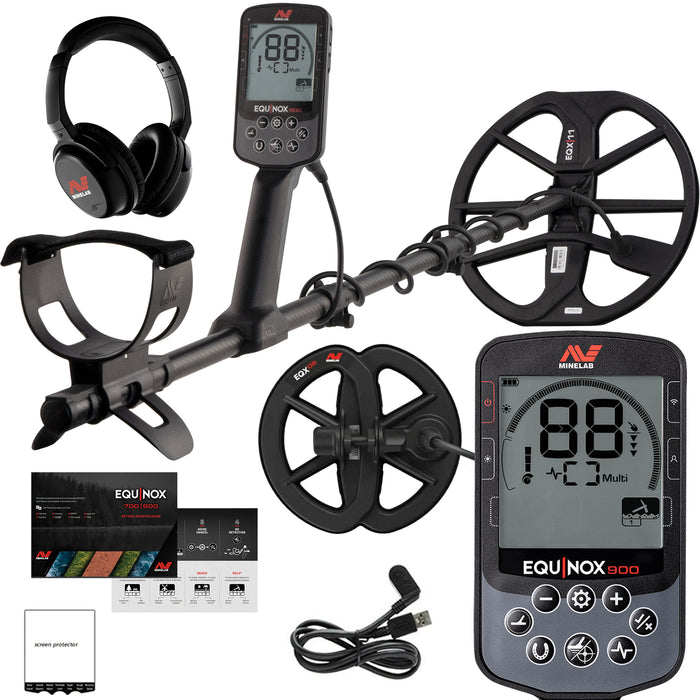
This is the standard Equinox 700 with everything Minelab supplies: the detector with the EQX11 11 inch Double-D Smart coil and skidplate installed, ML 85 low-latency wireless headphones, a quick start guide, a USB charging cable with magnetic connector, a screen protector and a 3-year warranty. It is the right choice if you already own a pinpointer or want to pick one separately.
Verified specifications
Multi-IQ plus single frequencies of 4, 5, 10 and 15 kHz
Park 1 and 2, Field 1 and 2, Beach 1 and 2 profiles
The same standard Equinox 700 package, plus a Minelab Pro-Find 35 waterproof pinpointer with holster. A pinpointer saves a lot of time finding small earrings and thin rings in the hole or the sand scoop, and it means smaller, neater holes in parks.
The table lists the Equinox 700 specifications Minelab publishes. Two figures are worth a short note because you will see different numbers around the web.
The first is weight. Minelab's marketing copy describes the detector as weighing 1.2 kg, which is a rounded figure. The technical specification lists 1.27 kg (2.8 lb), and that is the number we use throughout this review.
The second is sensitivity. The Equinox 700/900 instruction manual gives a range of 1 to 25 for the 700 and 1 to 28 for the 900, while Minelab's current online spec table shows 1 to 28 for both. We list the manual figure, so do not be surprised if your detector's menu reads differently after a software update. Everything else comes straight from Minelab's tech specs and the manual.
Specification
Minelab Equinox 700
Technology
Multi-IQ simultaneous multi-frequency
Search modes
Park 1 and 2, Field 1 and 2, Beach 1 and 2, plus All Metal shortcut
Custom search profiles
6 (2 per mode)
Operating frequencies
Multi-IQ, or single 4, 5, 10 or 15 kHz
Target ID
119 segments: ferrous -19 to 0, non-ferrous 1 to 99
Target tones
1, 2, 5, All Tones, Depth
Recovery Speed
1 to 3
Iron Bias
0 to 3 (Multi-IQ only)
Ground balance
Auto, Manual, Tracking
Noise cancel
Auto, 19 channels
Sensitivity
1 to 25 (manual)
Depth indicator
5 levels
Pinpoint mode
Yes
Display and keypad
Monochrome LCD, red backlight on display and keypad (Off, Low, High)
Flashlight
Yes, on the Control Pod
Vibration
Handgrip vibration for the ferrous tone region
Audio output
Built-in speaker, wired 3.5 mm (1/8 in) headphones, low-latency wireless
Supplied headphones
Minelab ML 85 low-latency wireless
Standard coil
EQX11 11" Double-D Smart coil with skidplate
Battery
Internal 3.7 V / 5100 mAh lithium-ion, about 12 hours typical runtime
Waterproof rating
IP68, submersible to 16 ft (5 m)
Length
56.7 in (144 cm) extended, 24 in (61 cm) collapsed
Weight
2.8 lb (1.27 kg)
Operating temperature
+14°F to +104°F (-10°C to +40°C)
Warranty
3 years, control box and coil
Source: Minelab Equinox 700 tech specs and the Equinox 700/900 instruction manual.
How Multi-IQ Works on the Equinox 700
A traditional VLF detector transmits one frequency at a time. Lower frequencies respond well to large, highly conductive targets such as silver coins, while higher frequencies are better at picking up small, low-conductive targets such as thin gold chains. Pick one and you give something up.
Multi-IQ is Minelab's answer to that trade-off. The Equinox 700 transmits across several frequencies at the same time and processes the results together, so one sweep covers a wider range of target types than any single frequency. Minelab says this also gives steadier Target IDs, especially in mineralized soil and wet salt sand, where single frequencies struggle to separate the target signal from the ground signal. For that reason Minelab recommends running Multi in every search mode.
The modes also shape how Multi-IQ behaves. Park 1 and Field 1 use a lower-frequency weighting suited to coins and general hunting, while Park 2 and Field 2 lean toward higher frequencies for small targets such as fine jewelry and hammered coins. Beach mode uses its own salt-focused processing and only runs in Multi.
Minelab states that the Multi-IQ engine is the same across the Equinox family, but the 700 and 900 have processor improvements over the older 600 and 800 that give better Iron Bias, target separation and discrimination depth. For background, our guides on what Multi-IQ is and multi-frequency technology explain it in plain terms.
Good to know
Multi-IQ does not guarantee you will find every target, and it does not make the 700 automatically deeper than every other detector. Results still depend on target size, depth and orientation, ground conditions, interference and your settings.
Single-Frequency Options: 4, 5, 10 and 15 kHz
Multi-IQ is simultaneous multi-frequency. The single-frequency settings are a separate option: press the Frequency button and the detector runs on just one frequency instead. The Equinox 700 offers 4, 5, 10 and 15 kHz.
Minelab's manual describes when a single frequency can help. If you only want large, highly conductive targets at depth, such as big silver coins, 4 or 5 kHz may give a slight edge. In a spot with heavy electrical interference that Noise Cancel cannot fully clear, a single frequency may pick up less noise than Multi. The cost is a narrower target range, so you are more likely to miss targets outside what that frequency favors.
A few rules apply. Single frequencies work in Park and Field modes only; Beach mode runs in Multi because salt conditions demand it. Iron Bias is only available in Multi. Minelab also recommends running an Auto Noise Cancel each time you change frequency.
The 700 has no 20 or 40 kHz option. Those higher frequencies, found on the Equinox 800 and 900, can help with very small gold, so this is one of the clearest differences between the 700 and its bigger siblings.
Park, Field and Beach Search Modes
Each mode has two profiles. Minelab sets up Profile 1 for general conditions and Profile 2 for harder ones, with more target sensitivity and a chance of extra noise. You can change and save the settings in any profile, and a long press on the Search Mode button resets that profile to its factory preset.
Park 1: General and CoinsThe profile Minelab suggests for learning the detector. It targets modern coins and larger jewelry and rejects Target IDs 1 and 2 by default to cut down on foil.
Park 2: Fine JewelryAccepts every non-ferrous target, uses a faster Recovery Speed to pull good targets out from around iron, and sets the audio to All Tones. Also a good start for freshwater.
Field 1: Coins and ArtifactsBuilt for plowed fields, pasture and old home sites with plenty of iron and coke. Rejects IDs 1 to 4 by default, which covers most coke signals.
Field 2: Fine Coins and ArtifactsSuits dense sites and is better at small hammered coins on edge or at depth, with a faster Recovery Speed.
Beach 1: Wet and Dry SandFor the beach and shallow water. Reduces the salt signal while keeping high transmit power for coins and jewelry.
Beach 2: Underwater and SurfLowers transmit power to calm the strong salt signal when you wade or the coil is fully submerged.
In both Beach profiles, the detector assigns leftover salt response a Target ID of 0 so gold chains and other low conductors stay easy to hear. On black sand beaches, an overload indicator appears when the detector reduces transmit power automatically, and full power returns once the icon clears.
Target ID, Discrimination and Target Separation
The Equinox 700 shows a Target ID from -19 to 99 across 119 segments. Negative numbers are ferrous, and positive numbers run from fine gold at the low end up to large silver at the top. Minelab's manual uses a US quarter as an example, which typically reads around 89. The finer the scale, the easier it is to learn the difference between a pull tab and a ring that reads a few numbers away.
Discrimination works segment by segment. You can build a pattern in the Accept/Reject menu, or press the Accept/Reject button when a target you do not want sounds off, and that ID is rejected from then on. The All Metal shortcut switches off your pattern with one press so you hear everything. A five-level depth indicator and a Pinpoint mode help you narrow down the target before you dig.
Recovery Speed and Iron Bias
These two settings are what Minelab means by target separation. Together they control how the detector reacts when several signals sit close together, from cutting down on dug iron to finding good targets in very trashy ground.
Recovery Speed sets how quickly the detector resets from one target to the next. The 700 offers levels 1 to 3. A higher setting separates targets that are close together, which helps in parks full of nails and bottle caps. The trade-off is less depth and slightly less Target ID accuracy, so lower settings make more sense in clean ground. The 900 has eight levels and a faster top speed.
Iron Bias helps the detector classify large or complex iron, such as rusty nails and crown bottle caps, as ferrous so it is easier to reject. The 700 offers 0 to 3, and it only works in Multi. Settings 0 to 2 keep more good targets near iron in play but let more iron through, so Minelab suggests pairing them with All Metal. Setting 3 suits dense iron and bottle-cap sites. Our guide to detecting in trashy areas shows how these settings work together on a real hunt.
Ground Balance, Sensitivity and Noise Cancel
Ground balance tunes the detector to the minerals in your soil so they do not cause false signals. The Equinox 700 offers Auto, Manual and Tracking ground balance, and the default setting of 0 is recommended for Park, Field and Beach modes because most of those sites carry less mineralization than goldfields. Tracking ground balance adjusts continuously and can help when using Beach 2 in salt water. Our article on ground balance explains the idea for newer hunters.
Sensitivity controls how strongly the detector responds to signals, and Minelab's advice is to run the highest setting that stays stable. Noise Cancel deals with electrical interference from power lines, electronics and other detectors nearby; the 700 has 19 channels and an Auto Noise Cancel that picks the quietest one in about five seconds. Manual channel selection is an Equinox 900 feature. Here is the setup order Minelab recommends:
Charge fully before the first hunt. Minelab recommends a full 6-hour charge before first use.
Pick the mode and profile for your site. Start in Park 1 on Multi if you are new to the detector.
Run an Auto Noise Cancel. Hold the coil still and away from the ground while it scans, and repeat it after every frequency change.
Ground balance if the ground is noisy. Hold the Accept/Reject button and pump the coil over clean ground until the number settles. At the beach, ground balance again after changing Noise Cancel, Recovery Speed or Iron Bias.
Set sensitivity last. Raise it with the coil still until false signals start, back off until they stop, then test over clear ground.
Audio, Wireless Headphones and Night Detecting Features
The 700 gives you several ways to read a target: sound in your ears, a buzz in the handle, and a lit screen. That matters, because most of what you learn about a target before digging comes from audio, and the lighting and vibration features let you keep going in poor light or noisy places.
Audio Controls and ML 85 Wireless Headphones
Target Tone offers 1, 2, 5, All Tones and Depth settings. With 2 or 5 tones, different ID ranges sound at different pitches. All Tones gives each Target ID its own pitch. Depth makes pitch and volume follow signal strength, so a shallow or large target sounds louder than a small or deep one, which gives you a feel for size and depth by ear. Volume runs from 0 to 25, and a threshold tone (off by default) can blank briefly to tell you a rejected target is under the coil.
On the 700, the ferrous tone region is the one you can fine-tune for volume, pitch and tone break. That lets you turn iron down to a low grunt and keep good targets loud. Full control over every tone region is reserved for the 900.
The included Minelab ML 85 headphones connect through Minelab's low-latency wireless audio, and they can also be used wired with their auxiliary cable. The detector has a built-in speaker and takes standard 3.5 mm wired headphones, as long as the plug's outer molding is under 9 mm wide so it fits the waterproof socket. More options are in our headphones collection.
Handgrip Vibration, Flashlight and Backlighting
Handgrip vibration gives tactile feedback that grows stronger with signal strength, both while detecting and in Pinpoint. On the Equinox 700 it can only be turned on for the ferrous tone region, so you feel iron through the handle rather than hearing every hit. It is not a silent mode for all targets. Per-tone vibration for every target type is an Equinox 900 feature, and master vibration is off by default.
The Control Pod flashlight switches on with a two-second press of the Backlight button and lights up your digging spot at dusk or on a night beach hunt. The display and keypad have a red backlight with Off, Low and High settings. Both start off each time you power on, and using them a lot shortens battery runtime.
Build, Weight and Portability
The Equinox 700 uses a three-piece carbon-fiber shaft locked with two camlocks. Fully extended it measures 56.7 in (144 cm), and collapsed it packs down to 24 in (61 cm), short enough to ride in a backpack or a carry-on bag. That is a real change from the original Equinox 800, whose shaft only collapses to 44.1 in (112 cm).
The detector weighs 2.8 lb (1.27 kg). Light weight matters more than it sounds: across a four-hour hunt, every extra ounce shows up in your forearm and shoulder.
The handgrip holds the internal battery and vibration motor, and the armrest adjusts along a rail with a strap to keep it secure. A kickstand lets you set the detector down without laying the control pod in the dirt. Minelab advises checking that the camlocks grip firmly before each hunt and tightening the thumbscrew slightly if the shafts start to slip. Keep the control pod on the supplied shaft, because the battery compartment only seals when it is assembled, and aftermarket shafts can stop it sealing properly.
Search Coil and Accessories
The standard coil is the EQX11, an 11 inch round Double-D Smart coil fitted with a skidplate. A DD coil is a good general choice: it covers a useful amount of ground per swing and handles mineralized soil and salt sand well. The skidplate protects the coil and is meant to be replaced once it wears thin. A pinpointer is not included in the standard box, so it is the first accessory most buyers add.
PinpointerFinds small targets in the hole or scoop much faster. Pick a waterproof model for wet sand and shallows. Shop pinpointers or choose one of the bundles above.
Extra coilsMinelab's 6 inch EQX06 suits tight, trashy spots and the 15 inch EQX15 covers open fields and beaches. Browse search coils.
Sand scoopThe most useful beach tool for recovering targets from dry and wet sand. Browse our sand scoops.
Battery and Charging
Power comes from an internal 3.7 V, 5100 mAh lithium-ion battery. Minelab gives a typical runtime of about 12 hours on a full charge. Heavy use of the backlight or flashlight brings that down, and the detector regulates voltage so performance stays the same as the battery drains.
Charging uses the supplied USB cable with a snap-on magnetic connector. From flat to full takes about 5 to 6 hours with a good charger rated at least 2A at 5V. Lower-powered USB ports, such as some laptop ports, take longer. Only charge between +32°F and +104°F (0°C and +40°C).
On land you can keep detecting with a USB power bank plugged in, which is handy on long trips. Do not use the detector underwater while it is charging or connected to a power bank. For storage, charge it fully every 3 to 4 months. The battery is not user-swappable; after a few years of use a Minelab service center can replace it.
Waterproofing and Underwater Use
The Minelab Equinox 700 is waterproof to IP68 and can be fully submerged to 16 ft (5 m). That covers wet sand, the surf line, wading in rivers and lakes, and shallow snorkeling. It does not make the detector suitable for unrestricted diving. Stay within the 16 ft rating; for deeper dive work, a dedicated underwater detector such as the Minelab Excalibur II is the better tool.
The rating applies with the control pod mounted on the supplied shaft and the headphone socket covered. Before you go under, make sure the waterproof dust cap is screwed firmly onto the headphone socket. An uncovered socket will not instantly damage the electronics, but it can corrode the socket and cause false headphone detection.
Headphones are a separate rating
The included ML 85 wireless headphones are not waterproof, and wireless audio does not work underwater. Minelab requires its own Equinox waterproof headphones for underwater detecting, because their threaded connector seals into the detector's socket. If you plan to hunt with your head below the surface, add the Minelab underwater waterproof headphones.
Use Beach 2 when you wade or the coil is fully submerged, and consider Tracking ground balance in salt water. After cold-water submersion the speaker can sound muffled for up to 30 minutes while internal air pressure settles, which is normal. After every beach or salt-water hunt, rinse the whole detector in fresh water, open both camlocks and flush them, and avoid wiping sand off, since that can scratch the surfaces. Planning to hunt lakes and rivers? Our roundup of deep water metal detectors compares other options.
How the Equinox 700 Performs in Different Places
This section is based on how Minelab designed each mode and setting. It tells you what the detector is built to do in each type of ground.
Parks and schoolyards. Park 1 is the starting point for coins and larger jewelry and rejects most foil by default. Switch to Park 2 when you want small jewelry, and raise Recovery Speed where nails and bottle caps crowd the ground. The 119-segment scale and the ability to reject single IDs help you skip repeat pull tabs.
Plowed fields and relic sites. Field mode rejects coke by default and is designed for hammered coins and artifacts mixed in with iron. Iron Bias and Recovery Speed matter most here, and Minelab says Multi-IQ gives steadier IDs in mineralized soil than a single frequency.
Salt beaches. This is where Equinox 700 beach detecting makes the strongest case. Beach mode runs on Multi-IQ only, gives salt a Target ID of 0, and lowers transmit power in surf or on black sand. With the 16 ft rating you can follow targets into the water. See more options in our beach metal detector collection.
Freshwater. Minelab suggests Park mode as a good starting point for lakes and rivers.
Gold. The 700 can find gold jewelry, and Multi-IQ and Park 2 cover low-conductive targets. What it lacks is Gold Mode, with its prospecting audio and high-frequency weighting, plus the 20 and 40 kHz single frequencies. For small natural nuggets in mineralized goldfields, the Equinox 900 or a dedicated gold detector is the better pick.
How Deep Can the Equinox 700 Detect?
Minelab does not publish a single depth figure for the Equinox 700, and any honest answer is "it depends." Target size and shape, how the target lies in the ground, how long it has been buried, soil mineralization, the coil you use, your sensitivity and recovery settings, and local interference all change how deep a target can be detected.
The five-level depth gauge gives a rough idea of how deep a detected target is. Minelab's manual uses a US quarter to illustrate the scale, with the arrows stepping from roughly 2 inches to more than 8 inches. It is a guide only, and it gets less accurate in highly mineralized soil.
Getting the most depth
Run Multi, use the highest stable sensitivity, keep Recovery Speed low in clean ground, perform Noise Cancel and ground balance properly, and consider the larger EQX15 coil for open ground. Our guide on improving detection depth goes through these steps in more detail.
Pros and Cons of the Equinox 700
Cons
No Gold Mode, which the Equinox 800 and 900 have
No 20 or 40 kHz single frequencies
Recovery Speed 1 to 3 and Iron Bias 0 to 3, versus 1 to 8 and 0 to 9 on the 900
Vibration works on ferrous targets only, and only the ferrous tone is adjustable
No manual Noise Cancel and no User Profile button
Underwater use needs separate Minelab waterproof headphones
Minelab Equinox 700 vs Equinox 800 vs Equinox 900
All three are Multi-IQ detectors, but they come from two generations. The 800 launched first, with the 600, and the 700 and 900 arrived in 2022 with newer processing, the collapsible carbon-fiber shaft and a deeper waterproof rating. The table shows Minelab's standard specifications. Retailer bundles can add a second coil, pinpointer or bag, but those extras are not part of the standard detector.
Feature
Equinox 700
Equinox 800
Equinox 900
Search modes
Park, Field, Beach
Park, Field, Beach, Gold
Park, Field, Beach, Gold
Gold Mode
No
Yes
Yes
Multi-IQ
Yes, with 700/900 processor improvements
Yes, original 600/800 processing
Yes, with 700/900 processor improvements
Single frequencies
4, 5, 10, 15 kHz
5, 10, 15, 20, 40 kHz
4, 5, 10, 15, 20, 40 kHz
Waterproof
16 ft (5 m), IP68
10 ft (3 m)
16 ft (5 m), IP68
Target ID
119 segments
50 segments
119 segments
Sensitivity
1 to 25
1 to 25
1 to 28
Recovery Speed
1 to 3
1 to 8
1 to 8
Iron Bias
0 to 3
0 to 9 (different scale)
0 to 9
Custom profiles
6
8, plus User Profile button
8, plus User Profile button
Noise cancel
Auto
Auto and Manual
Auto and Manual
Tone customization
Ferrous tone only
Ferrous and non-ferrous
Every tone region
Vibration
Ferrous only
No
Per tone region
Flashlight
Yes
No
Yes
Backlight
Red display and keypad, 3 levels
White display, no keypad light
Red display (4 levels) and keypad
Weight
2.8 lb (1.27 kg)
2.96 lb (1.34 kg)
2.8 lb (1.27 kg)
Shaft
3-piece carbon fiber, 24 in (61 cm) collapsed
44.1 in (112 cm) collapsed
3-piece carbon fiber, 24 in (61 cm) collapsed
Standard coils
11" DD
11" DD
11" DD + 6" DD
Wireless audio
ML 85 headphones included
ML 80 Bluetooth headphones and WM 08 module included
ML 85 headphones included
Battery
3.7 V / 5100 mAh
3.7 V / 5000 mAh
3.7 V / 5100 mAh
Our price (Nov 6, 2026)
$749.00
Sold out
$999.00
Minelab notes that Iron Bias is set up differently on the 600/800 than on the 700/900, so the numbers do not line up one to one. Some bundles have paired the 800 with a free 6" coil; that coil is a retailer extra, not standard.
Equinox 700 vs 800
The Equinox 800 adds Gold Mode and the 20 and 40 kHz single frequencies, more Recovery Speed and Iron Bias steps, manual Noise Cancel, a User Profile button and tone control over both ferrous and non-ferrous regions. If gold nuggets or finer tuning are your priority, those are real advantages.
The 700 answers with newer hardware. It is waterproof to 16 ft instead of 10 ft, has 119 Target IDs instead of 50, weighs less, collapses to 24 in instead of 44.1 in, and adds a flashlight, keypad backlight and ferrous vibration that the 800 does not have. It also benefits from the processor improvements Minelab built into the 700 and 900.
For coin, relic and beach hunting, most buyers will be better served by the 700. For gold, the 800's Gold Mode counts, but the 900 brings that same feature on the newer platform, which makes it the more natural step up today. Every Equinox 800 listing on our store showed as sold out when we checked on November 6, 2026.
Equinox 700 vs 900
The 700 and 900 share the same body, shaft, weight, 16 ft waterproof rating, 119-segment Target ID, battery and ML 85 headphones. The differences are in the controls and the box.
The 900 adds Gold Mode with its own prospecting audio, 20 and 40 kHz single frequencies, Recovery Speed 1 to 8 and Iron Bias 0 to 9, sensitivity up to 28, manual Noise Cancel, a User Profile button, full tone customization and vibration on any tone region. It also ships with a second coil, the 6 inch EQX06, alongside the 11 inch.
At $999.00 for the standard Equinox 900 against $749.00 for the 700, the gap is fair if you will use Gold Mode or the extra tuning. If you mainly hunt parks, fields and beaches with factory profiles, the 700 delivers most of what matters. Our full Equinox 700 vs 800 vs 900 guide goes deeper.
The Equinox 900 is the step up for hunters who want Gold Mode or full control over audio and target separation. It shares the 700's 16 ft waterproof body, 2.8 lb weight and carbon-fiber shaft, and adds the 6 inch EQX06 coil in the box, which is a real help on trashy park and beach sites.
Verified specifications
Multi-IQ plus single frequencies of 4, 5, 10, 15, 20 and 40 kHz
Hobbyists and beginners who want premium features and room to grow
Beach and park detectorists who need waterproof, all-terrain capability
Treasure hunters looking for fast recovery speed and accurate target identification
Coin, relic and jewelry hunters who want one detector for parks, fields and salt beaches
The Equinox 700 for beginners. It is not the cheapest way into the hobby, but it is a sensible first detector if you are serious about sticking with it. Minelab recommends starting in Park 1 on Multi, and the preset profiles mean you can switch from a park to a beach by pressing one button. The deeper settings, such as Iron Bias, Tone Break and tracking ground balance, are tucked into advanced menus, so you can leave them alone until you are ready. The main learning curve is the menu system; spend an hour with the manual before your first hunt. If you are just starting out, our beginner metal detector guide covers the basics.
Who Should Consider Another Detector?
The Equinox 700 covers a lot of ground, but some detectorists will be happier with something else:
Gold prospectors working mineralized goldfields for small nuggets. The Equinox 900's Gold Mode, or a gold-focused detector, is built for that job.
Hunters who want every dial. If you like shaping every tone region, picking noise channels by ear or saving a User Profile, the 900 gives you those controls on the same body.
Divers going deeper than 16 ft (5 m). The 700's rating stops there, so look at a dedicated underwater detector.
Tight budgets or kids. If $749.00 is more than you want to spend on a first machine, Minelab's lower-priced lines in our Minelab detector collection are a better starting point.
Most coin, relic and jewelry hunters who split their time between parks, fields and beaches will not hit these limits often.
Where to Buy the Minelab Equinox 700?
Buy from an authorized dealer: Detector Warehouse sells genuine Minelab products with the full 3-year warranty.
Free shipping on orders of $99 and up, and 98% of orders ship within 24 hours.
Exclusive bundle deals with extra accessories, such as the pinpointer packages above.
Questions before you buy? Call our team at 844-344-4465.
Minelab Equinox 700 FAQs
Is the Minelab Equinox 700 a good metal detector?
Yes. For coins, relics, jewelry and salt beaches it is one of the strongest choices in its price range, thanks to Multi-IQ, 119 Target IDs, a 16 ft (5 m) waterproof rating, light weight and included wireless headphones. Its main limits are no Gold Mode and fewer adjustment steps than the Equinox 900.
Is the Equinox 700 suitable for beginners?
Yes, if you are serious about the hobby. The preset Park, Field and Beach profiles work straight out of the box, and Minelab recommends starting in Park 1 on Multi. Advanced settings sit in separate menus you can learn later. It costs more than entry-level detectors, but you are less likely to outgrow it.
How deep can the Equinox 700 detect?
Minelab does not publish a single depth figure. Depth depends on target size, shape and orientation, soil mineralization, the coil and your settings. The five-level depth gauge gives an approximate reading. Running Multi, using the highest stable sensitivity, keeping Recovery Speed low in clean ground and ground balancing properly all help.
Is the Equinox 700 fully waterproof?
The detector is rated IP68 and can be submerged to 16 ft (5 m) when mounted on its supplied shaft with the headphone dust cap fitted. It is not rated beyond that depth. The included ML 85 wireless headphones are not for underwater use, so you need Minelab's Equinox waterproof headphones to hunt underwater.
Can the Equinox 700 be used in saltwater?
Yes. Beach mode runs on Multi-IQ, which Minelab says handles salt better than any single frequency. Beach 1 is for wet and dry sand, and Beach 2 is for wading and surf. Rinse the detector with fresh water after every saltwater hunt.
What is Multi-IQ technology?
Multi-IQ is Minelab's simultaneous multi-frequency technology. Instead of transmitting one frequency at a time, the detector transmits and processes several at once, covering a wider range of targets and giving steadier Target IDs in mineralized or salty ground. The Equinox 700 can also run on a single frequency of 4, 5, 10 or 15 kHz.
Does the Equinox 700 have Gold Mode?
No. The Equinox 700 has Park, Field and Beach modes only, and no 20 or 40 kHz single frequencies. It can still detect gold jewelry and other gold targets with Multi-IQ, but for nugget prospecting in mineralized ground the Equinox 900's Gold Mode or a dedicated gold detector is better suited.
What search coils come with the Equinox 700?
The Equinox 700 comes with one coil, the EQX11 11 inch round Double-D Smart coil with a skidplate, installed on the detector. Minelab's 6 inch EQX06 and 15 inch EQX15 Equinox coils are sold separately.
Does the Equinox 700 include wireless headphones?
Yes. Minelab ML 85 low-latency wireless headphones are included, and they can also be used wired with their auxiliary cable. The detector also has a built-in speaker and a socket for standard 3.5 mm wired headphones.
What is the difference between the Equinox 700 and 900?
The 900 adds Gold Mode, 20 and 40 kHz single frequencies, Recovery Speed 1 to 8, Iron Bias 0 to 9, sensitivity up to 28, manual Noise Cancel, a User Profile button, full tone customization, vibration on any tone region and a second 6 inch coil. Both share the same 16 ft waterproof rating, 119 Target IDs, weight and shaft.
Is the Equinox 700 good for beach detecting?
Yes, beach detecting is one of its strongest uses. Beach mode runs on Multi-IQ, gives salt a Target ID of 0, and lowers transmit power in surf or on black sand. With its 16 ft (5 m) rating you can follow targets into the water, as long as you use Minelab waterproof headphones underwater.
How long does the Equinox 700 battery last?
Minelab gives a typical runtime of about 12 hours from the internal 3.7 V, 5100 mAh lithium-ion battery. Heavy backlight or flashlight use shortens it. A full charge takes about 5 to 6 hours with a 2A, 5V USB charger, and you can run the detector from a power bank on land.
How much does the Equinox 700 weigh?
Minelab's technical specification lists 2.8 lb (1.27 kg). Some marketing material rounds this to 1.2 kg. Collapsed, the detector measures 24 in (61 cm).
Final Verdict: Is the Equinox 700 Worth It?
The Minelab Equinox 700 is a well-rounded metal detector that gives most of the Equinox 900's hardware for a lower price. You get Multi-IQ simultaneous multi-frequency, Park, Field and Beach modes, 119 Target IDs, a 16 ft (5 m) IP68 rating, a 2.8 lb carbon-fiber build that packs down to 24 in, and wireless headphones, a flashlight and vibration in the box.
What you give up is clear: no Gold Mode, no 20 or 40 kHz option, fewer steps on Recovery Speed and Iron Bias, vibration on ferrous targets only, and limited tone customization. You will also need Minelab's waterproof headphones if you plan to hunt underwater.
For a coin, relic or jewelry hunter who works parks, fields and salt beaches, yes, it is worth buying. It covers all three without a second detector, and the factory profiles are good enough that you do not have to master every menu to find targets. If you are a gold prospector, or you want full control over audio and target separation, the Equinox 900 is the better long-term buy. Need help choosing? Call our team at 844-344-4465.
How we checked this review: specifications come from Minelab's Equinox 700 tech specs and the Minelab Equinox 700/900 instruction manual. Prices, stock and package contents come from Detector Warehouse product pages, checked November 6, 2026.



Leave a comment