
Expert Support
(844) 344 - 4465
(844) 344-4465

Few things are more maddening than a detector that finds a target, loses it, then finds it again. One sweep gives a strong tone, the next gives nothing. An intermittent detector is almost never a random fault — the signal is telling you something about the target, the ground, the coil cable, the battery, or the settings, and this guide explains how to read it.
Note the pattern: signals that come and go over one spot usually mean a deep or awkward target; random chirps mean EMI or ground problems; fading or cutting out points to power trouble.
The most common causes:
Start with the simplest test: hold the coil still in the air, away from ground and metal. If it goes quiet, the problem is the ground, the target, or your sweep. If it keeps chirping, the problem is the machine, the cable, or the power supply.
This is the most common reason for an intermittent signal, and it is not a fault. Garrett's Ace Apex manual states it directly: intermittent signals typically mean a deep target or one at a difficult angle. A coin lying flat gives a clean, repeatable signal; the same coin on edge or near your depth limit gives a broken signal on some sweeps and none on others. Iron, and two targets close together, behave the same way.
Fix: sweep from several directions — turn 90 degrees and sweep again. A real target usually repeats from at least one direction; ground noise will not. Slow down, and switch to an all-metal or zero-discrimination mode — Garrett's manual recommends ZERO mode, or the pinpoint button, when signals are inconsistent. Use pinpoint to narrow the exact spot before you dig. Learning to identify and interpret metal detector signals will help you tell a genuine deep-target signal from ground noise.
If the detector works with the coil still but cuts out or chirps when you sweep, suspect the coil cable — the most common hardware cause. The cable flexes with every sweep and is clamped where it enters the coil housing and at the control box plug. Over time the wires inside can break under intact insulation, so the connection makes and breaks as the cable moves.
Fix: unscrew the locking ring, pull the plug out, inspect the pins for bent, dirty, or corroded contacts, then push it back in squarely and tighten the ring by hand. Flex-test the cable with the detector on and the coil still in the air: flex at the plug, along its length, and where it enters the coil — chirps at one spot mean the break is there. Re-wrap the cable snugly around the shaft.
A nearly empty battery does not always announce itself with a low-battery icon. On many detectors the first sign is erratic behaviour: intermittent signals, fading audio, or drifting ground balance. This applies to rechargeable lithium packs (Minelab Equinox, Nokta Legend, XP Deus) and AA-powered machines (Garrett ACE series). Cold weather makes it worse, since voltage drops in the cold. Corroded terminals cause the same symptoms — even a thin film can interrupt power as the machine moves.
Fix: charge fully or fit fresh batteries before you hunt; never start on a half-charged pack. On AA machines, replace all cells at once — mixing old and new cells causes uneven voltage. Clean corroded terminals with isopropyl alcohol.
EMI is invisible, it comes and goes, and it can make a healthy detector behave as if it is broken. Power lines, electric fences, phone towers, solar inverters, and other detectors all radiate noise your detector can pick up. The tell-tale sign: the machine is noisy even with the coil held motionless in the air.
Fix: run noise cancel or change frequency — most modern detectors, such as the Minelab Equinox 900, scan for the quietest channel. Reduce sensitivity until the threshold steadies, and move a few dozen yards from the source. Keep your coil several feet from a hunting partner's coil, and turn off your phone's data — a phone searching for signal near the coil is a common source of EMI.
Ground balance tells your detector to ignore the soil's mineral content and listen only for metal. When it is wrong — set for different soil than the ground you are standing on — the machine reacts to the ground itself. Raising and lowering the coil then produces a false target response that comes and goes. It is worst on iron-rich red soil, black sand, and hot-rock ground.
Fix: re-ground-balance on the spot. Pump the coil up and down over clean ground until the audio is smooth; on automatic machines, keep ground tracking on, and rebalance whenever the ground changes. Lower sensitivity in heavily mineralized ground — maximum sensitivity is not maximum depth.
The plastic skid plate (coil cover) protecting your search coil is also a trap. Sand, black-sand fines, and mineralized mud work their way between the coil and the cover, and because that material moves as you sweep, it generates intermittent responses that look exactly like a faulty coil.
Fix: remove the coil cover and clean it. Wash the coil face and the inside of the cover, and check for trapped grit — do this after every beach session and regularly on land. Check for trapped water and inspect the cover for cracks.
An intermittent signal is sometimes a technique problem. Sweeping too fast gives the detector too little time to process a weak target, so the signal appears on one pass and not the next. A coil held too high loses depth and makes marginal targets flicker. Lifting or tilting the coil at the end of a sweep produces inconsistent responses. Most detectors need the coil moving, so standing still over a target makes the signal fade.
Fix: slow down to about one metre (three feet) per second, with the coil in a steady arc. Keep the coil low and level, about 2–5 cm (one to two inches) above the ground, for the whole sweep. Overlap each pass by half the coil's width. The ultimate beginner metal detector guide covers sweep speed and coil control in more detail.
Electronics drift with temperature. Take a detector from a warm house or a hot car into cold open ground and the circuitry needs time to acclimatise — during that period the threshold can drift, the ground balance can shift, and signals can come and go. Severe cases can need 30 minutes to settle. Water causes similar problems: a pinhole crack in the coil housing can let moisture in, and the fault comes and goes as the water moves. A cracked solder joint from a drop behaves the same way.
Fix: let the machine acclimatise for ten to fifteen minutes in the hunting environment, then re-ground-balance. If water is suspected, remove the battery and dry the machine in a warm place for 24 hours. DetectorWarehouse's winter metal detecting gear guide also covers battery care and moisture protection in cold weather. Tap-test the coil in the air — chirps point to a loose internal connection. If the fault persists after drying, it is a repair-shop job.
| Test | How to do it | Meaning |
|---|---|---|
| Coil in the air | Hold coil still, 3 ft off ground | Still noisy = EMI, cable, battery, or electronics |
| Fresh battery | Swap in a known-good battery | Fixed = power was the cause |
| Reseat the connector | Unplug, inspect pins, plug back firmly | Fixed = loose or dirty connector |
| Cable flex test | Flex cable at plug, mid-cable, coil entry | Chirps at one spot = broken wire |
| Noise cancel + lower sensitivity | Run noise cancel, drop sensitivity 3–4 points | Fixed = EMI or ground balance |
| Swap the coil | Fit a different coil if available | Fixed = coil fault. Persists = control box |
If the swap test points to the detector rather than the coil, a modern multi-frequency machine with noise cancel and ground tracking is the fix:
★★★★★ 4.8 out of 5 (38 reviews)
Best for: detectorists whose swap test points to the detector — a modern multi-frequency machine with noise cancel and ground tracking.
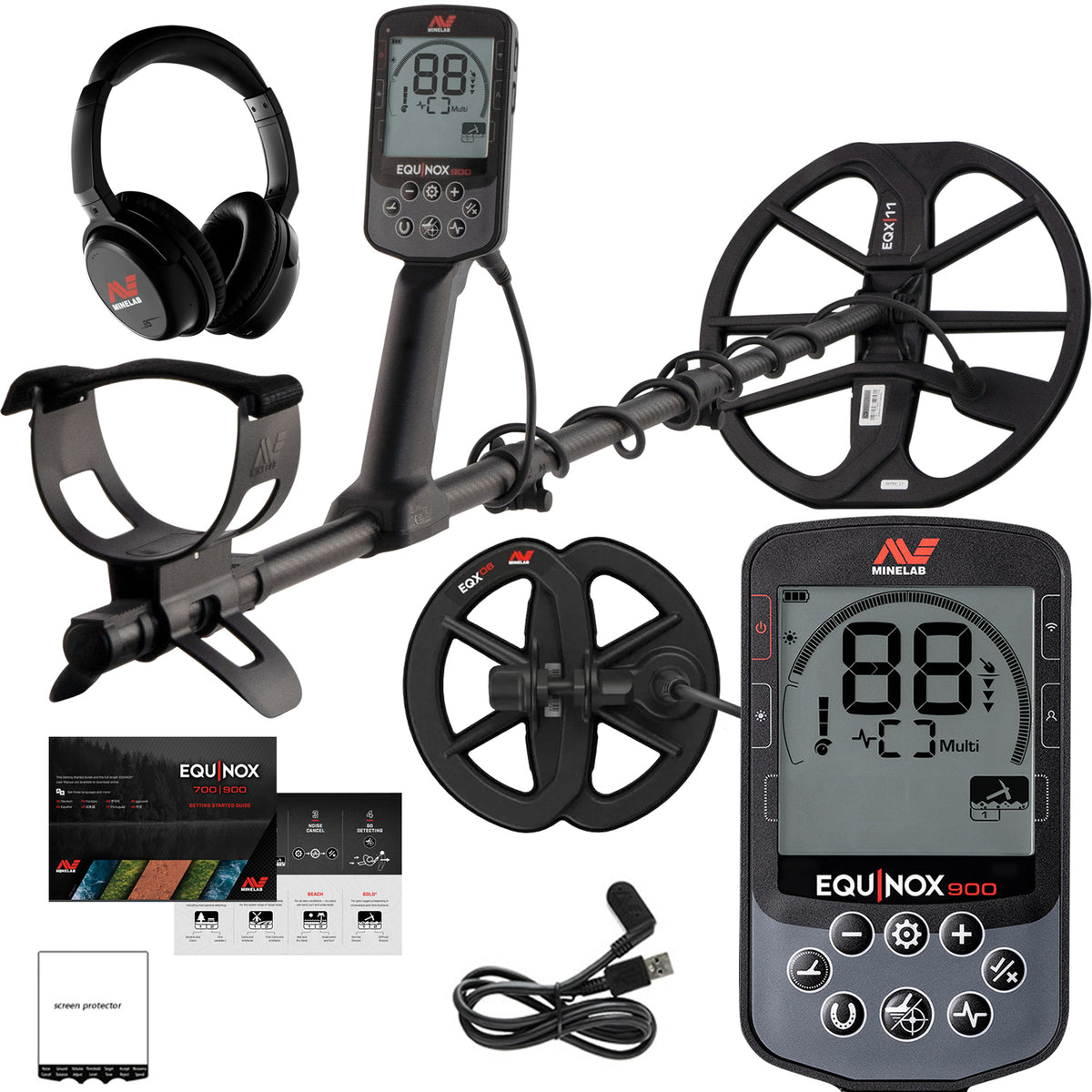
The Equinox 900 runs Minelab's Multi-IQ technology with a 119-point Target ID system and is waterproof to 5 m (16 ft). It ships with 11-inch and 6-inch DD coils, so you can swap coils to test whether a fault follows the coil or the control box.
Ideal user: detectorists who want one machine that can swap coils to test whether a fault follows the coil or the control box.
Shop the Equinox 900Check out more options in the DetectorWarehouse Minelab Equinox collection.
Book a repair if the machine stays noisy with the coil motionless in the air, a fresh battery fitted, and the connector reseated; if the flex test triggers faults or there is visible cable or coil damage; if a known-good coil shows the same fault, pointing to the control box; or if the machine shuts down on its own or shows an error code. Under warranty, do not open it yourself.
A single beep that does not repeat is usually a deep target at the edge of range, a piece of iron, or a brief burst of EMI. Sweep the spot again slowly from a different direction. If it repeats, dig it. If not, it was ground noise or interference.
A target on edge, or two targets close together, can respond strongly one way and weakly the other. Turn 90 degrees and sweep crosswise, then pinpoint the exact spot before digging.
The ground is different. Mineralization, wet salt sand, EMI, and temperature changes all affect the machine. Re-ground-balance on site, run noise cancel, and reduce sensitivity until stable.
Yes — it is one of the most common hardware causes. A wire broken inside the insulation makes and breaks contact as the cable moves. Flex-test the cable at the plug, along its length, and where it enters the coil.
Usually a battery sagging under load, or temperature drift as the electronics warm up or cool down. Swap in a fresh battery and re-ground-balance. If it repeats every session, the battery is the prime suspect.
A factory reset is a useful diagnostic step — it returns sensitivity, discrimination, ground balance, and frequency to known-good defaults. Note your settings first, reset, and test.
An intermittent detector usually means a deep or angled target, a loose coil cable, a tired battery, interference, or ground that needs rebalancing. The coil-in-the-air test splits the causes in half: quiet in the air means ground or technique; noisy in the air means machine, cable, or power supply. Work through the table one step at a time, and keep a spare battery and a clean coil cover in your kit. If the fault persists after every test, compare current metal detectors before deciding between a repair and a replacement.
Sources: Garrett Ace Apex user manual (Garrett Electronics); Garrett ACE 200i owner's manual (Garrett Electronics); C.Scope CS9000 professional metal detector manual; "Why Your Metal Detector Keeps Falsing" (DetectorGear); "Troubleshooting Common Metal Detector Problems" (Treasure Valley Metal Detecting Club); Find's Treasure Forums coil diagnostics thread (FindMall).
Not sure which detector or accessory fits your hunting style?
Talk to a detector expert and we will help you choose.
Call (844) 344-4465{"one"=>"Select 2 or 3 items to compare", "other"=>"{{ count }} of 3 items selected"}


Leave a comment