
Expert Support
(844) 344 - 4465
(844) 344-4465

Updated: November 6, 2026
Looking for a solid metal detector? The Minelab Equinox 700 and 900 are both great options. They use Multi-IQ technology, work in all terrains, and are fully waterproof. But which one is best for you?
Here is the short version. Both detectors run the same Multi-IQ engine, the same 119-segment Target ID scale and the same 5 m (16 ft) waterproof housing. The Equinox 900 adds Gold Mode, two extra single frequencies, wider adjustment ranges and a second 6-inch coil in the box. Below we explain each difference, which ones matter for the way you hunt, and a few claims that get repeated online but are not true, like the idea that the 900 always detects deeper.
Quick Answer
Biggest difference: only the Equinox 900 has Gold Mode and the 20 kHz and 40 kHz single frequencies. It also gives you finer control (Recovery Speed 1 to 8 vs 1 to 3, Iron Bias 0 to 9 vs 0 to 3, Sensitivity 1 to 28 vs 1 to 25) and ships with a second coil, the EQX06 6-inch Double-D.
Choose the Equinox 700 if you hunt parks, fields and beaches for coins, jewelry and relics and want strong results with fewer settings to learn.
Choose the Equinox 900 if you want to prospect for natural gold, hunt sites full of iron and trash, or like tuning tones, recovery and iron handling yourself.
Is the extra cost justified? For gold hunters and hands-on tuners, usually yes. For coin and beach hunters who stay in the presets, the 700 delivers the same core engine and waterproofing for less. On November 6, 2026 the base Equinox 700 was $749.00 and the base Equinox 900 with both coils was $999.00 at Detector Warehouse.
Detector specifications in this table come from Minelab's official tech specs. The last two rows cover what changes by retail listing: pinpointers and price. Rows marked in red are the specs where the two models differ.
| Feature | Equinox 700 | Equinox 900 |
|---|---|---|
| Multi-IQ Technology | Yes | Yes |
| Search Modes | Park, Field, Beach | Park, Field, Beach, Gold |
| Custom Search Profiles | 6 (2 per mode) | 8 (2 per mode) |
| User Profile Button | No | Yes |
| Frequencies | Multi-IQ plus 4, 5, 10, 15 kHz | Multi-IQ plus 4, 5, 10, 15, 20, 40 kHz |
| Waterproof Rating | IP68, 5 m (16 ft) | IP68, 5 m (16 ft) |
| Target ID Range | 119 segments | 119 segments |
| Target ID Scale | Ferrous -19 to 0, non-ferrous 1 to 99 | Ferrous -19 to 0, non-ferrous 1 to 99 |
| Recovery Speed | 1-3 | 1-8 |
| Iron Bias Settings | 0-3 | 0-9 |
| Sensitivity | 1 to 25 | 1 to 28 |
| Ground Balance | Auto, Manual, Tracking | Auto, Manual, Tracking |
| Noise Cancel | Auto, Continuous Auto | Auto, Continuous Auto, Manual |
| Target Tones | 1, 2, 5, All Tones, Depth | 1, 2, 5, All Tones, Depth |
| Tone Breaks | Ferrous only (t1) | Ferrous and non-ferrous (t1 to t4) |
| Tone Pitch and Volume | Tone 1 adjustable, 0 to 25 | All tones adjustable, 0 to 25 |
| Threshold Pitch | Fixed | 0 to 25 |
| Wireless Audio | Low latency wireless, ML 85 included | Low latency wireless, ML 85 included |
| Vibration | Ferrous vibration on or off | Ferrous vibration plus per tone region |
| Display Backlight (red) | High, Low, Off | High, Medium, Low, Off |
| Keypad Backlight and Flashlight | Yes | Yes |
| Weight | 1.27 kg (2.8 lbs) | 1.27 kg (2.8 lbs) |
| Shaft | 3-piece carbon fiber, 61 cm collapsed, 144 cm extended | 3-piece carbon fiber, 61 cm collapsed, 144 cm extended |
| Battery | 3.7 V, 5100 mAh Li-ion, about 12 hours | 3.7 V, 5100 mAh Li-ion, about 12 hours |
| Coils in the Minelab Box | EQX11 11" Double-D | EQX11 11" Double-D + EQX06 6" Double-D |
| Warranty | 3 years, control box and coil | 3 years, control box and coil |
| Pinpointer | Not included as standard. Available in bundle listings | Not included as standard. Available in bundle listings |
| Detector Warehouse Price | $749.00 base listing (checked November 6, 2026) | $999.00 base listing with both coils (checked November 6, 2026) |
Most of what makes an Equinox an Equinox is shared. Both models run Minelab Multi-IQ, read targets on the same 119-segment Target ID scale (ferrous -19 to 0, non-ferrous 1 to 99) and carry the same IP68 rating to 5 m (16 ft). They use the same 3-piece carbon fiber shaft, weigh the same 1.27 kg (2.8 lbs) and run on the same built-in 5100 mAh lithium-ion battery, which Minelab rates at about 12 hours with wired headphones.
You also get the same everyday tools on both: Pinpoint Mode, an All-Metal shortcut, Auto, Manual and Tracking ground balance, a 5-level depth indicator, Depth Pitch audio, a control pod flashlight, red display and keypad backlights, handgrip vibration and ML 85 low latency wireless headphones in the box. Both are covered by a 3-year warranty on the control box and coil, and both accept every Minelab EQX coil.
Minelab also says the 700 and 900 share processor upgrades over the older Equinox 600 and 800, giving better Iron Bias, target separation and discrimination depth. That matters when you shop used: a 700 is not a cut-down 800, it is a newer platform with a lighter shaft, a wider Target ID scale and a deeper waterproof rating.
This is the most common mix-up. Multi-IQ transmits and processes several frequencies at the same time, so one sweep reads small gold and large silver without you switching anything. Both the 700 and 900 have it, and Minelab states the Multi-IQ engine is the same across every Equinox model.
The single frequencies are a separate option. When you select 10 kHz, for example, the detector stops running Multi-IQ and works on that one frequency only. Minelab's own guidance is that Multi is generally the better choice on an Equinox, with single frequencies kept for specialist situations, such as a site where one frequency runs quieter or responds better to a certain target. So the 900's extra frequencies widen your specialist options. They do not give it a stronger Multi-IQ. If you want the background on how simultaneous multi-frequency works, read What is Multi-IQ? and our guide to multi-frequency technology.
Key point
Multi-IQ is standard on both detectors. The 900's extra frequencies are single-frequency options, not a stronger version of Multi-IQ.
The Equinox 700 offers four single frequencies: 4, 5, 10 and 15 kHz. The Equinox 900 offers the same four plus 20 kHz and 40 kHz, for six in total. Both also run Multi-IQ, which is where most people hunt most of the time. Note that the 700 does include 4 kHz. Some spec lists leave it out, but Minelab lists it for both models.
Why do the extra two matter? Minelab's rule of thumb is simple. Lower frequencies penetrate the ground better and suit larger, more conductive targets like silver coins. Higher frequencies are more sensitive to small, low-conductive targets such as tiny gold nuggets, thin gold chains and small hammered coins, but they do not reach as far into the ground. The 20 kHz and 40 kHz options give the 900 a dedicated high end for those small targets, which is why prospectors care about them.
Depth myth
What the extra frequencies do not do is make the 900 a deeper detector across the board. A higher frequency trades reach for sensitivity to small items. If your hunting is coins and rings in parks or on the beach, you will likely spend nearly all your time in Multi-IQ on either model, and the 20 and 40 kHz options will rarely change your day.
Single frequencies are worth testing when a site is noisy from electrical interference, when you want to compare how a target reads at two frequencies before digging, or when you are hunting very small gold. On the 700 you can do that across 4 to 15 kHz. On the 900 you can push all the way to 40 kHz. For tips on setting a detector up for small gold, see our gold detector settings guide.
Both detectors share three search modes, each with two profiles you can customize and save. Park 1 is set up for modern coins and larger jewelry, and Minelab calls it the ideal profile for learning the Equinox. Park 2 targets smaller items in trashy ground, with faster recovery and more audio detail. Field 1 is for general hunting with strong trash rejection, including coke. Field 2 suits high target density and helps with small hammered coins on edge or at depth. Beach 1 handles wet and dry sand, and Beach 2 is built for wading or working with the coil underwater, where the salt signal is strongest.
The Equinox 900 adds Gold Mode with two profiles. Gold 1 is for small nuggets in mild ground. Gold 2 is for deeper nuggets in difficult ground and uses a lower recovery speed. Both default to Tracking ground balance, because most goldfields have shifting iron mineralization, and both use audio processing so a target changes in volume and pitch as you pass over it. That continuous response helps you hear faint, small nuggets that a standard beep might hide.
Do you need Gold Mode?
Gold Mode is a prospecting tool. You do not need it to find gold rings at the beach or gold jewelry in a park, and Minelab says Park 2 and Field 2 on the 700 can still find natural gold well thanks to stable Multi-IQ Target IDs. Where Gold Mode earns its place is nugget hunting in mineralized ground, where small targets sit in noisy soil.
The extra mode also explains the profile count: 6 custom profiles on the 700 (two per mode) and 8 on the 900. The 900 also adds a User Profile button, which lets you jump to a saved setup with one press. If prospecting is your main goal, compare other options in our gold prospecting metal detectors collection too.
These three controls decide how well a detector sorts good targets from trash. The 700 and 900 share the same Target ID system. The difference is how much control the 900 gives you over recovery speed, iron handling and the tones that go with each ID.
Both models show 119 Target IDs: 20 ferrous values from -19 to 0 and 99 non-ferrous values from 1 to 99. You can accept or reject each segment, so you can notch out a pull-tab range and keep a nickel range, for example. A wider scale gives you more information before you dig, which Minelab says helps you judge whether a target is worth recovering.
The gap is in tone breaks. On the 700 you can set one break, between ferrous and non-ferrous (t1). On the 900 you can move breaks t1 through t4 across the non-ferrous range, so different conductivity groups can each get their own tone. In practice that lets you hear the difference between a likely foil target and a likely coin without looking at the screen.
Recovery speed sets how quickly the detector resets after one target so it can read the next. Higher settings separate targets sitting close together, which helps in trashy parks and old homesites. Lower settings give the detector more time on each signal, which can help with depth in clean ground but can blur targets that sit side by side.
The Equinox 700 has three levels, 1 to 3. The Equinox 900 has eight, 1 to 8. The 900 does not separate targets better by default. It gives you finer steps, so you can find the exact point where separation and stability balance for your site. For technique that works on any detector, read how to detect in trashy areas.
Iron Bias controls how the detector treats iron that might fool it into sounding like a good target. A low setting lets more iron sound diggable, which also gives you the best chance of catching a valuable non-ferrous target hiding next to iron. A higher setting cuts false tones from iron, at some risk of missing a good target in the mix.
The Equinox 700 offers Iron Bias 0 to 3. The Equinox 900 offers 0 to 9. Minelab says the Iron Bias on both is improved over the 600 and 800 and is based on the older F2 setting, so there is no separate F2 option. Again, the 900 gives finer steps rather than a different system.
Sensitivity runs from 1 to 25 on the Equinox 700 and 1 to 28 on the Equinox 900. The 900's three extra steps are useful when ground and interference are quiet enough to run that high. They are not a promise of extra depth. Minelab is clear that detection depth depends on target size, orientation and metal, ground mineralization, and electrical noise, which is why it does not publish a single depth figure for either model. In noisy or heavily mineralized ground, most users run the highest setting that stays stable, and on many days that number is the same on both detectors.
Ground balance works the same way on both. You can use Auto, set it manually, or switch on Tracking so the detector follows changing ground as you hunt. Tracking is the default in the 900's Gold Mode because goldfields often change from one swing to the next. If ground balance is new to you, our guide on what ground balance means in metal detecting covers when to use each method.
Noise cancel is where the 900 adds one more option. Both models offer Auto and Continuous Auto noise cancel, which pick a quieter operating channel when power lines, phones or other detectors cause chatter. The 900 adds Manual noise cancel, so you can choose the channel yourself when auto selection is not quite clean enough. That is handy at group hunts and near power lines, but most users get stable results from the auto options on either model.
Takeaway
The takeaway for buyers: the 900's wider ranges reward people who like to tune. If you prefer to load a preset and swing, the 700's ranges already cover what most sites call for.
Both detectors offer the same target tone options: 1, 2, 5, All Tones and Depth. Depth Pitch is worth knowing about. It gives continuous pitch audio with no threshold, with separate sounds for ferrous and non-ferrous targets. Weaker signals from small or deep targets come through at a lower pitch, and strong signals from large or shallow targets come through higher. Both models also let you set ferrous volume from 0 to 25 so iron can sit quietly in the background.
The 900 goes further with tone customization. On the 700 you can adjust pitch and volume for tone 1, and the threshold pitch is fixed. On the 900 you can adjust pitch and volume for every tone, set threshold pitch from 0 to 25, and place tone breaks across the non-ferrous range. If you hunt by ear, that extra control is one of the most useful parts of the upgrade.
Both models ship with Minelab ML 85 headphones and use Minelab low latency wireless audio, so there is no noticeable lag between the coil passing a target and the sound in your ears. You can also use the built-in speaker or wired 3.5 mm (1/8-inch) headphones.
Two points save a lot of frustration. First, Minelab states that standard Bluetooth headphones and the older WM 08 wireless module are not compatible with the Equinox 700 or 900, and these models do not currently pair with hearing aids. Second, wireless audio is for land and shallow wading. For deep wading or full submersion, Minelab recommends its waterproof headphones, which seal into the headphone socket. When you are not using a headphone cable, keep the waterproof cap screwed into the socket, especially when washing the detector. You can find replacement and upgrade sets in our headphones collection.
Both models have a flashlight, red backlight display, and handgrip vibration for night detecting. However, the 900 has more lighting and vibration options, giving it an edge for low-light hunts.
Here is exactly what that means. On the Equinox 700, the red display backlight has High, Low and Off settings, and vibration can be switched on or off for ferrous targets. On the Equinox 900, the display backlight adds a Medium level, and vibration can be set per tone region as well as for ferrous targets, so you can feel the difference between target groups through the handle.
Both models share a red keypad backlight with High, Low and Off settings and a flashlight built into the control pod, which helps when you are checking a hole at dusk or reading the screen at an early morning beach hunt. Vibration is also useful in the surf, around loud traffic, or any time you would rather feel a target than hear it.
There is no physical difference between the two. Both use a 3-piece carbon fiber shaft that collapses to 61 cm (24 in) and extends to 144 cm (56.7 in), with an adjustable armrest. At 1.27 kg (2.8 lbs), both are lighter than the older Equinox 600 and 800, and the collapsed length fits in a backpack or carry-on.
Waterproofing is identical too. Both carry an IP68 rating and are submersible to 5 m (16 ft). The 900 is not built for deeper water than the 700. Minelab says both models go through drop tests up to 1 m, flex tests and water ingress tests. To keep the seals in good shape, rinse the detector with fresh water after beach or water use, never use solvents, and never grease the seals, since petroleum-based grease damages them and voids the warranty. If water hunting is your focus, browse our underwater metal detectors and beach metal detectors.
The battery is the same 3.7 V, 5100 mAh lithium-ion pack in the handle. Minelab rates it at about 12 hours from a full charge using wired headphones. A quality 2 A USB charger fills it in about 4 hours, while a standard 0.5 A computer port takes around 18 hours. You can run either detector from a USB power bank on land to extend a long day, but Minelab says not to take it underwater while it is connected to a power bank or charging. Qualcomm QuickCharge chargers are not compatible.
The battery can be replaced, and Minelab recommends an authorized service center so the waterproof seal is not damaged. Both models use the same magnetic USB charging cable, which also fits the Equinox 600, 800, Manticore and X-Terra Pro.
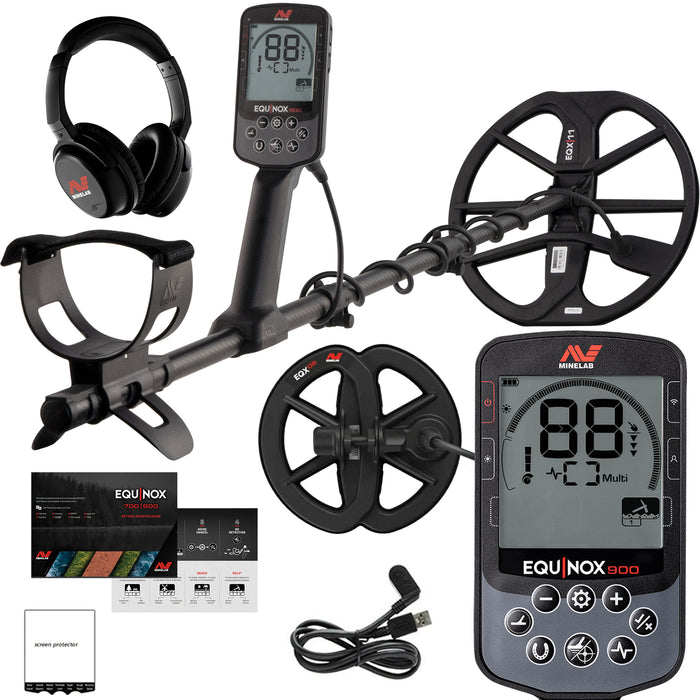
Here is what Minelab puts in the box. The Equinox 700 comes with the EQX11 11-inch Double-D coil with skid plate, ML 85 wireless headphones, a magnetic USB charging cable and screen protectors. The Equinox 900 comes with the same items plus the EQX06 6-inch Double-D coil with skid plate.
The 6-inch coil is a real advantage in tight spots. Minelab notes that smaller coils are lighter, easier to work between rocks and roots, and better in heavy trash because they are less likely to see two targets at once. The 11-inch coil covers more ground per swing and is the better all-rounder. Both coils fit either detector, so a 700 owner can add the EQX06 later, along with the EQX15 15 x 12-inch coil for wide open ground. See our search coils collection for options.
Good to know
A pinpointer is not standard equipment with either model. Pro-Find pinpointers and padded bags come only with our bundle listings, not in the Minelab box. Check the title and contents of the listing before you order.
Bundle listings and prices on November 6, 2026:
Prices and bundles change, so the product page is always the final word. If you are new to pinpointers, read how to use a pinpointer, or browse all pinpointers.
Because both detectors share Multi-IQ and the same Target ID scale, their results in most places come down to settings and the coil you use. Here is how the differences play out by location.
Parks and yards. Expect modern coins, jewelry and plenty of foil, pull-tabs and bottle caps. Both models handle this well in Park 1 and Park 2. The 900 helps when trash is dense, thanks to the 6-inch coil, finer recovery speed steps and extra tone breaks that separate foil-range targets from coin-range targets by ear.
Fields and relic sites. Field 1 and Field 2 are shared, including coke rejection and Field 2's focus on small coins on edge. Iron is the main challenge in old sites, and here the 900's 0 to 9 Iron Bias and 1 to 8 recovery speed give you room to fine tune. A 700 at its top settings still covers most fields well.
Beaches and shallow water. This is close to a tie. Both have Beach 1 for wet and dry sand and Beach 2 for wading and submerged work, the same 5 m waterproof rating, and automatic black sand handling that lowers power to avoid overload. Gold jewelry at the beach does not need Gold Mode. Remember to use waterproof headphones if you go deeper than wading depth.
Goldfields. This is where the 900 pulls clearly ahead. Gold 1 and Gold 2, Tracking ground balance by default, gold-tuned audio, 20 and 40 kHz single frequencies and the 6-inch coil are all built for small nuggets in mineralized ground. The 700 can find gold in Park 2 and Field 2, but it lacks those dedicated tools. In extremely hot ground or for deep large nuggets, a dedicated gold detector may still be a better fit than either Equinox.
For most beginners, the Equinox 700 is the better first detector. It has fewer menus and settings to learn, its ranges are simple (three recovery speed steps and four Iron Bias steps), and it costs less, which leaves room in the budget for a digger, a pinpointer and a pouch. Minelab suggests starting in Park 1, which is set up to teach you how the Equinox sounds before you move to specialist settings.
That does not mean the 900 is hard to use. The presets work the same way on both, so a new user can turn on a 900, pick Park 1 and start hunting. The difference is that the 900 offers more to adjust later, and some beginners find a long list of settings distracting before they know what each one changes. A good rule: if you would not miss Gold Mode, the extra coil or advanced tone control in your first year, start with the 700.
There are two cases where a beginner should start with the 900. The first is anyone who already knows they want to prospect for natural gold, since the 700 has no Gold Mode. The second is a fast learner who wants one detector to grow into for years without upgrading. In both cases, learn the presets first and change one setting at a time so you can hear what each adjustment does.
Whichever you choose, the skills transfer. Both share the screen layout, Target ID scale and controls, so moving from a 700 to a 900 later is straightforward. For more help choosing a first machine, read our ultimate beginner metal detector guide or browse beginner metal detectors. Our Equinox 700 review also covers the 700 in more detail.
On November 6, 2026, our base Equinox 700 listing was $749.00 and our base Equinox 900 listing, which includes both coils, was $999.00. That is a $250 gap at those prices. Here is what the extra money buys.
What the 900 adds
What it does not add: a different Multi-IQ engine, more waterproofing, a wider Target ID scale, a lighter build or guaranteed extra depth. Those are the same on both.
So the 900 is worth it if you will use at least one of its main extras. Gold prospectors should get it. Hunters who work iron-heavy relic sites or trashy parks and like to tune will get real value from the finer controls and the 6-inch coil. If you mostly hunt beaches and parks in the presets, the 700 gives you the same core performance and lets you put the savings toward accessories. Prices change often, so check the current price on each product page. If you would like to spread the cost, see our financing options.
Both cards below link to the base detector listings, with exactly what Minelab ships in the box. For pinpointer and bag bundles, see the bundle list above or the full Minelab Equinox collection.
The Equinox 700 is the one we suggest to most coin, jewelry, relic and beach hunters. It runs the same Multi-IQ engine as the 900, reads targets on the same 119-segment Target ID scale and goes under water to the same 5 m (16 ft). What you give up is Gold Mode, the 20 and 40 kHz frequencies and the second coil, and for park and beach hunting most people never miss them.
It is also the easier machine to learn. Three recovery speed steps, four Iron Bias steps and one tone break mean fewer settings to second guess, and Park 1 is a strong place to start on day one. The money you save over the 900 covers a pinpointer, a digger and a pouch. If you want more detail on how it performs, our Equinox 700 review covers it in depth.

Best Value | Parks, Fields and Beaches
Minelab Equinox 700
Minelab
Minelab Equinox 700 Waterproof Multi-Frequency Metal Detector with 11" DD Coil
$749.00 $1,204.00 Save $455
Price checked November 6, 2026
The Equinox 900 is the pick for gold prospectors and for detectorists who like to tune their machine to each site. It adds Gold 1 and Gold 2, the 20 and 40 kHz single frequencies, Recovery Speed 1 to 8, Iron Bias 0 to 9, Sensitivity 1 to 28 and full control over every tone, threshold pitch and tone break.
It also ships with the EQX06 6-inch coil alongside the 11-inch, which makes a real difference in trashy parks, rocky ground and tight spots. Everything else, from the carbon fiber shaft and weight to the waterproof rating and battery, matches the 700. If you are weighing it against another brand, read our Nokta Legend vs Equinox 900 buying guide.
Best for Gold and Advanced Tuning
Minelab Equinox 900
Minelab
Minelab Equinox 900 Waterproof Multi-Frequency Metal Detector with 11" and 6" DD Coils
$999.00 $1,299.00 Save $300
Price checked November 6, 2026
Go for the Equinox 700 if:
Go for the Equinox 900 if:
Both detectors are great, but your choice depends on your budget and needs. If you want gold-hunting power and extra features, go for the Equinox 900. If you need a solid, all-around detector at a lower price, the Equinox 700 is perfect.
Still deciding? Call our team at (844) 344-4465 and tell us where you hunt. You can also compare the Equinox against other models on our metal detector comparison chart, read our Nokta Legend vs Equinox 900 buying guide, or browse all Minelab metal detectors.
The Equinox 900 adds Gold Mode, 20 kHz and 40 kHz single frequencies, wider control ranges (Recovery Speed 1 to 8, Iron Bias 0 to 9, Sensitivity 1 to 28) and full tone customization. It also ships with a second coil, the EQX06 6-inch Double-D. Both use the same Multi-IQ engine, 119-segment Target ID and 5 m (16 ft) waterproof rating.
Not automatically. Both run the same Multi-IQ engine, and Minelab does not publish a depth figure for either model because depth depends on target size, ground mineralization and interference. The 900 gives you more room to fine tune sensitivity, recovery speed and iron bias, which can help in some ground, but it is not a built-in depth upgrade.
Yes. Multi-IQ simultaneous multi-frequency is standard on both the Equinox 700 and the Equinox 900. Minelab states the Multi-IQ engine is the same across all Equinox models. The single frequencies are an extra option you can switch to, not a replacement for Multi-IQ.
No. Gold Mode is only on the Equinox 900. The 700 has Park, Field and Beach modes. Minelab notes that Park 2 and Field 2 in Multi-IQ can still find gold, so the 700 is not blind to gold, but it lacks the dedicated gold audio and settings.
The Equinox 900 adds 20 kHz and 40 kHz single frequencies. Both models share Multi-IQ plus 4, 5, 10 and 15 kHz, so the 900 has six single frequency options and the 700 has four.
Yes. The Equinox 700 and Equinox 900 have the same IP68 rating and are waterproof to 5 m (16 ft). The 900 is not more waterproof than the 700. For deep wading or full submersion, use Minelab waterproof headphones, since the included ML 85 wireless headphones are not designed to go underwater.
Yes. Minelab ships the Equinox 900 with the EQX11 11-inch Double-D coil and the EQX06 6-inch Double-D coil, both with skid plates. The Equinox 700 comes with the EQX11 only.
No. A pinpointer is not part of the Minelab box for either model. Detector Warehouse sells separate bundle listings that add a Pro-Find 35 or Pro-Find 40 pinpointer. Check the title and contents of the exact listing you buy.
It is worth it if you will use what it adds: Gold Mode, 20 and 40 kHz, the 6-inch coil and finer tuning controls. If you mostly hunt parks and beaches in the presets, the Equinox 700 gives you the same core engine, Target ID scale and waterproofing for less.
The Equinox 700 is the easier starting point for most beginners. It has fewer settings to learn, strong presets, and costs less. A beginner who already knows they want to prospect for gold or wants room to grow into advanced settings can start with the 900.
The Equinox 900. It is the only one with Gold Mode, which Minelab designed for small nuggets in mineralized ground, plus 20 kHz and 40 kHz and the 6-inch coil. For dedicated nugget hunting in very hot ground, a purpose-built gold detector may still be the better tool.
Yes. All Minelab EQX coils, including the EQX06 6-inch, EQX11 11-inch and EQX15 15 x 12-inch, fit every Equinox model. You can add the 6-inch coil to a 700 later as an accessory.
Both use Minelab low latency wireless audio with the included ML 85 headphones. Minelab states that standard Bluetooth headphones and the older WM 08 module are not compatible with the Equinox 700 or 900. Wired 3.5 mm headphones work on both.
Minelab rates both models at about 12 hours from a full charge with wired headphones. Both use the same built-in 3.7 V, 5100 mAh lithium-ion battery, which takes about 4 hours to charge with a quality 2 A USB charger.
{"one"=>"Select 2 or 3 items to compare", "other"=>"{{ count }} of 3 items selected"}


Leave a comment